
Paskha
In its own language: па́сха
Molded sweet cheese made for Orthodox Easter celebrations
Paskha is a festive dairy dish from Russia and Ukraine, prepared for Orthodox Easter. Made mainly from pressed curd cheese (tvorog), it is shaped in a mold and often includes butter, eggs, sour cream, raisins, almonds, vanilla, and candied fruit. It is brought to church to be blessed and served with Easter breads.
- Made from pressed curd cheese called tvorog
- Traditionally shaped in a pyramid mold for Easter
- Decorated with religious symbols and candied fruits
- Brought to church to be blessed on Easter
- Served with Easter breads like kulich and paska
What is Paskha?
Paskha is a sweet, creamy dish made mainly from tvorog, a type of curd cheese similar to cottage cheese. The cheese is pressed and sieved until smooth, then mixed with rich ingredients like butter, eggs, sour cream, raisins, almonds, vanilla, and sometimes candied fruits. The mixture is shaped in a mold, often forming a truncated pyramid, and decorated with religious symbols or nuts and fruits. Its white color is meant to symbolize purity and the joy of Easter.
Where does Paskha come from?
Paskha comes from Russia and Ukraine, where it is closely tied to Orthodox Easter traditions. Its name is taken from Pascha, the Orthodox celebration of Easter. The shape of the mold, a truncated pyramid, is said to recall the first Passover or symbolize the Trinity and the Church. The dish is also found among the Orthodox Karelian minority in Finland. Paskha was created as a way to use foods forbidden during Lent, making it a rich and celebratory dish for the end of the fasting period.
How is Paskha made?
To make paskha, tvorog is first pressed to remove excess liquid and then sieved for a smooth texture. For cooked paskha, the mixture is gently heated to form a custard before adding other ingredients. For uncooked versions, the ingredients are simply mixed at room temperature. The mixture is placed in a mold lined with cheesecloth and chilled for several hours. Once set, it is turned out, decorated, and served. Modern versions may use plastic molds or simply mound the mixture on a plate.

How and when is Paskha eaten?
Paskha is prepared during Holy Week and brought to church on Easter to be blessed. It is often served alongside rich Easter breads, such as paska in Ukraine and kulich in Russia. The dish is usually part of a festive Easter meal, shared with family and friends after the end of Lent. It is sometimes included in an Easter basket with other celebratory foods for the blessing ceremony.
Kinds of Paskha
Paskha can be made cooked or uncooked. Cooked paskha uses an egg custard base, while uncooked versions rely on the raw pressed cheese. The uncooked type is usually made in smaller quantities since it does not keep as long. Decorations and added ingredients can vary, with some versions featuring more nuts, spices, or candied fruits. In Finland, paskha is also enjoyed by the Orthodox Karelian community.
What Paskha means
Paskha holds deep religious meaning for Orthodox Christians, symbolizing purity and the joy of Christ’s resurrection. The dish is decorated with symbols like the Orthodox cross and Cyrillic letters for 'Christ is Risen.' Bringing paskha to church for blessing is a key Easter tradition. Its association with foods forbidden during Lent makes it a special treat marking the end of fasting and the arrival of Easter.
When Paskha is on the table
Questions people ask about Paskha
What is paskha made of?
Paskha is made from tvorog (pressed curd cheese), butter, eggs, sour cream, raisins, almonds, vanilla, and candied fruits. These ingredients are mixed and shaped in a mold.
Where does paskha come from?
Paskha is a traditional dish from Russia and Ukraine, and is also found among the Orthodox Karelian minority in Finland. It is closely tied to Orthodox Easter celebrations.
When is paskha eaten?
Paskha is prepared during Holy Week and eaten at Easter, after being blessed in church. It is a festive food marking the end of Lent.
How is paskha served?
Paskha is served cold, often decorated with religious symbols, nuts, or candied fruits. It is usually eaten with Easter breads like kulich or paska.
Why is paskha molded into a pyramid shape?
The pyramid shape is said to symbolize the first Passover, the Trinity, or the Church. It is a traditional form for paskha, especially for Easter celebrations.
Good reading and sources
- Paskha (Russian-Style Farmers’ Cheese)Saveur, Recipe
- BBC - Radio 4 Woman's Hour -Easter Cooking: Provencal Easter Soup and Pashka, Russia's traditional Easter dessertBBC, Recipe
The facts on this page come from the Wikipedia article "Paskha", written by its contributors and used under the CC BY-SA 4.0 licence, and from its Wikidata record (CC0). Thali rewrote the text in its own words, with AI assistance, and compares every page with the article to make sure no passage is copied. It may be reused under the same CC BY-SA 4.0 licence with a link back.
It may contain mistakes, and it is not dietary or allergy advice: recipes differ from cook to cook. If something is wrong, tell us. Last refreshed 2026-10-03.
More from Russia
All the food of Russia Pancake
🇺🇸 United States and 5 moreFlat cakes made from batter, cooked on a griddle or pan and served sweet or savoury
Main dish, Breakfast, Snacks
Pancake
🇺🇸 United States and 5 moreFlat cakes made from batter, cooked on a griddle or pan and served sweet or savoury
Main dish, Breakfast, Snacks
 KamaVegetarianталқан
🇪🇪 Estonia and 5 moreRoasted grain and legume flour mixed with milk or buttermilk
Main dish, Breakfast, Snacks
KamaVegetarianталқан
🇪🇪 Estonia and 5 moreRoasted grain and legume flour mixed with milk or buttermilk
Main dish, Breakfast, Snacks
 Kissel
🇷🇺 Russia and 5 moreA sweet, thickened fruit or grain dessert from Eastern and Central Europe
Sweet or dessert, Snacks
Kissel
🇷🇺 Russia and 5 moreA sweet, thickened fruit or grain dessert from Eastern and Central Europe
Sweet or dessert, Snacks
Its cousins elsewhere
All sweets and desserts PanettoneVegetarian
🇮🇹 Italy and 2 moreTall, sweet Italian bread with candied fruit, eaten at Christmas and New Year
Sweet or dessert, Breakfast, Tea time
PanettoneVegetarian
🇮🇹 Italy and 2 moreTall, sweet Italian bread with candied fruit, eaten at Christmas and New Year
Sweet or dessert, Breakfast, Tea time
 King cake
🇫🇷 France and 5 moreA festive sweet bread or pastry with a hidden token, eaten for Epiphany and Carnival
Pie or savoury pastry, Snacks, Tea time
King cake
🇫🇷 France and 5 moreA festive sweet bread or pastry with a hidden token, eaten for Epiphany and Carnival
Pie or savoury pastry, Snacks, Tea time
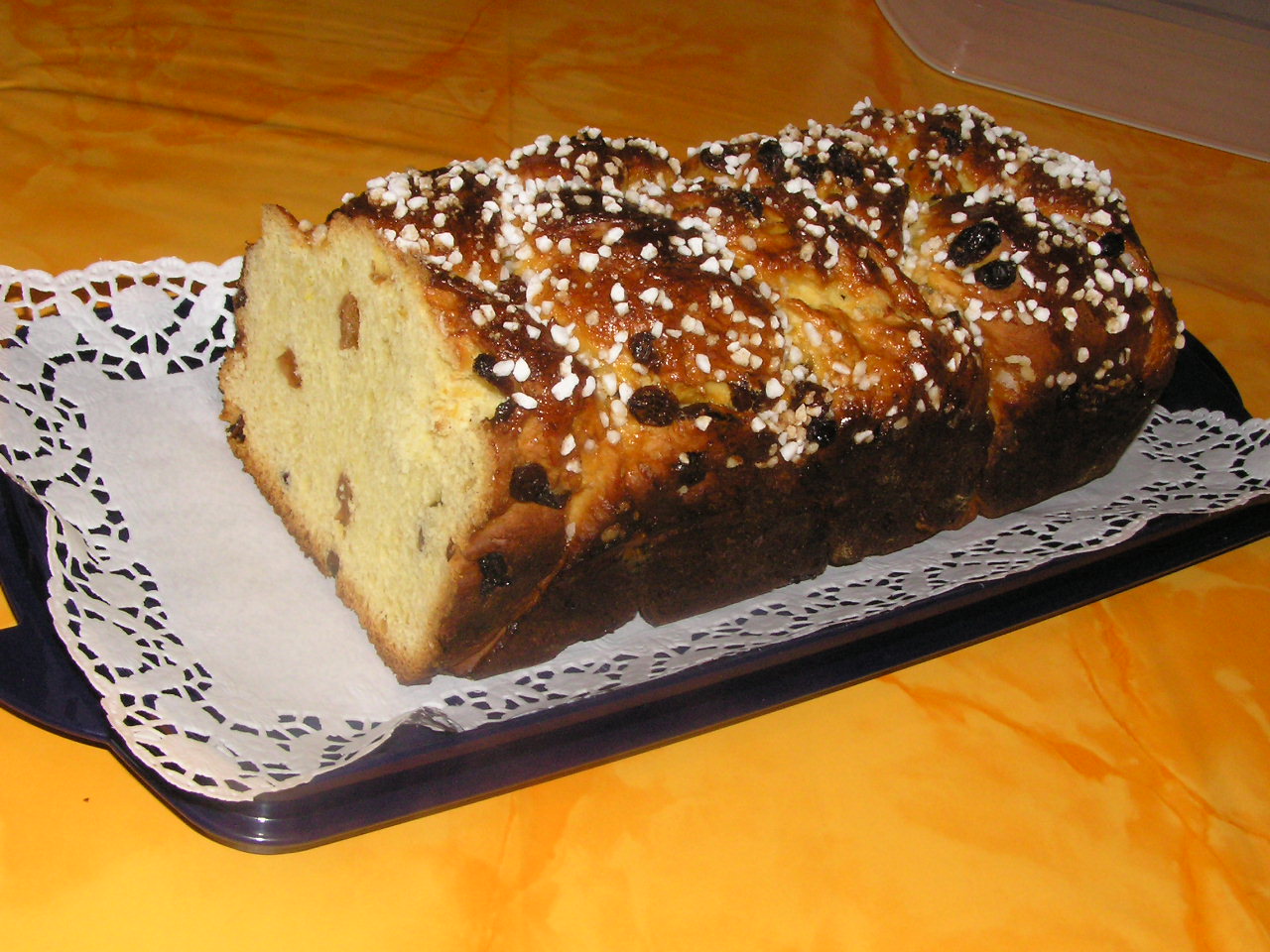 Cozonac
🇷🇴 Romania and 4 moreA sweet, enriched bread often filled with nuts or dried fruit, baked for Easter
Sweet or dessert, Tea time, Snacks
Cozonac
🇷🇴 Romania and 4 moreA sweet, enriched bread often filled with nuts or dried fruit, baked for Easter
Sweet or dessert, Tea time, Snacks
 PapanașiVegetarian
🇷🇴 Romania and 1 moreCheese-based doughnuts or dumplings topped with cream and fruit preserves
Pie or savoury pastry
PapanașiVegetarian
🇷🇴 Romania and 1 moreCheese-based doughnuts or dumplings topped with cream and fruit preserves
Pie or savoury pastry