
Sangak
In its own language: سَنگَگ
Triangular Iranian flatbread baked on hot river stones
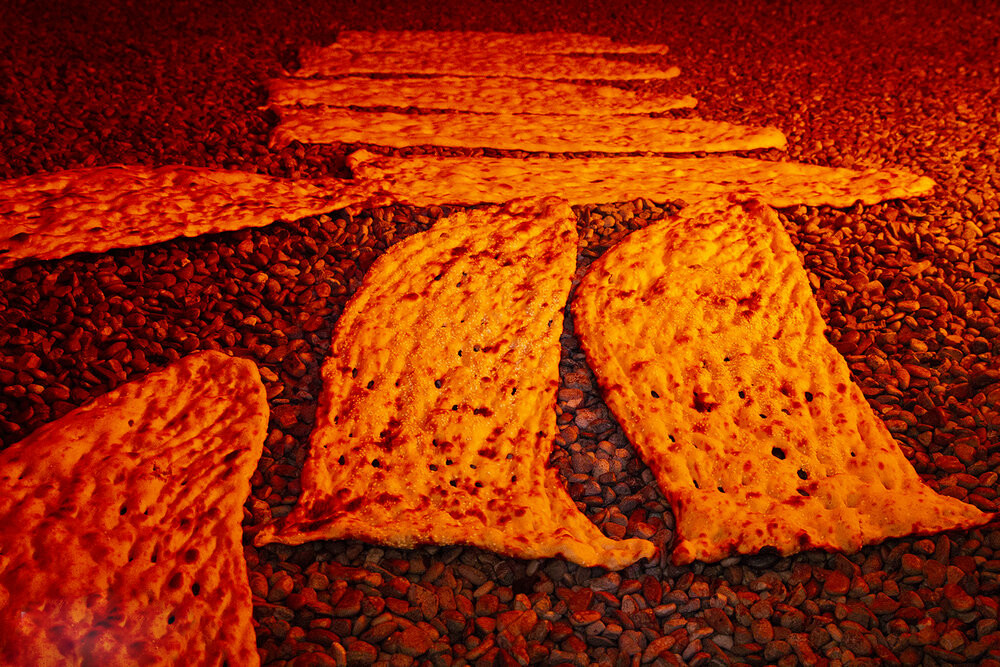
Sangak is a traditional Iranian whole wheat flatbread, shaped into a triangle and baked directly on smooth river stones. Made from a high-hydration, leavened dough, it is often topped with sesame or poppy seeds and is sold fresh in bakeries across Iran. Sangak is eaten as part of everyday meals.
- Baked directly on smooth river stones for a dimpled texture
- Triangular shape, often very large
- Traditionally topped with sesame or poppy seeds
- Dates back to at least the 11th century
- National bread of Iran
What is Sangak?
Sangak is a flat, triangular bread made from whole wheat flour and sourdough. Its surface is uneven and dimpled, with a mix of chewy and crisp areas. The bread is often topped with sesame or poppy seeds, though some versions are plain. It is baked on a bed of smooth river stones, which gives it a unique texture and appearance. The finished bread can be quite large and is typically sold fresh, sometimes still warm from the oven.
Where does Sangak come from?
The name 'sangak' means 'pebble' in Persian, referring to the river stones used in baking. Sangak dates back at least to the 11th century and was once the bread of the Persian army, with soldiers carrying pebbles to build makeshift ovens. It has long been a staple in Iran and was also common in Azerbaijan before the Soviet era, when industrial bread production led to its decline there. Today, sangak is recognized as the national bread of Iran.
How is Sangak made?
To make sangak, bakers prepare a very wet, leavened dough, usually with a mixing machine. The dough is scooped and shaped into a rough triangle on an oiled metal peel with a long handle. Toppings like sesame or poppy seeds may be added. The dough is then slid onto a rotating oven tray covered with river stones, where it stretches and bakes. After baking, the bread is removed with a long hook, shaken to remove any pebbles, and cooled on a metal mesh before being sold.


How and when is Sangak eaten?
Sangak is eaten as an everyday bread in Iran, often bought fresh from bakeries. It is sometimes paired with grilled meats such as Persian lamb kabob, as was traditional in the army. The bread is usually torn or cut into pieces and served with meals. In bakeries, it may be hung on nails or stacked on racks, and customers often buy it as soon as it is cool enough to handle.
Kinds of Sangak
There are two main types of sangak: plain, and topped with seeds. The seeded version, using sesame or poppy seeds, is considered more expensive. Occasionally, bakers add other toppings like cumin, black cumin, caraway, or dried herbs. Some bakeries are known for making especially long sangak, and the skill of stretching and baking the bread is a point of pride.
What Sangak means
Sangak holds a special place in Iranian daily life as the national bread. Its traditional baking method and distinctive texture set it apart from other breads. In the past, it was closely linked to the Persian army and communal baking. Today, sangak bakeries are a familiar sight in Iranian cities, and the bread is an everyday staple, reflecting both heritage and local pride.
Questions people ask about Sangak
What is sangak made of?
Sangak is made from whole wheat flour, sourdough, and sometimes topped with sesame or poppy seeds. The dough is leavened and has a high water content.
Where does sangak come from?
Sangak is from Iran, where it is considered the national bread. It has also been eaten in Azerbaijan, especially before the 20th century.
How is sangak baked?
Sangak is baked on a bed of smooth river stones in a special oven. The dough is stretched and placed on the stones, which gives the bread its characteristic texture.
What does sangak look and taste like?
Sangak is a large, flat, triangular bread with a dimpled surface. It has both chewy and crisp parts, and may be topped with seeds for extra flavor.
Is sangak eaten every day or for special occasions?
Sangak is an everyday bread in Iran, commonly bought fresh from bakeries and eaten with various meals.
Good reading and sources
The facts on this page come from the Wikipedia article "Sangak", written by its contributors and used under the CC BY-SA 4.0 licence, and from its Wikidata record (CC0). Thali rewrote the text in its own words, with AI assistance, and compares every page with the article to make sure no passage is copied. It may be reused under the same CC BY-SA 4.0 licence with a link back.
It may contain mistakes, and it is not dietary or allergy advice: recipes differ from cook to cook. If something is wrong, tell us. Last refreshed 2026-10-03.
More from Iran
All the food of Iran Tandoor breadVegan
🇮🇶 Iraq and 5 moreFlatbread baked on the walls of a clay tandoor oven
Bread, Breakfast, Lunch
Tandoor breadVegan
🇮🇶 Iraq and 5 moreFlatbread baked on the walls of a clay tandoor oven
Bread, Breakfast, Lunch
 SheermalVegetarianشیرمال
🇮🇷 Iran and 2 moreA sweet, saffron-scented flatbread made with milk and cardamom
Bread, Breakfast, Lunch
TaftanVegetarianتافتان
🇮🇷 Iran and 1 moreLeavened Iranian bread baked in a clay oven, sometimes scented with saffron
Bread
SheermalVegetarianشیرمال
🇮🇷 Iran and 2 moreA sweet, saffron-scented flatbread made with milk and cardamom
Bread, Breakfast, Lunch
TaftanVegetarianتافتان
🇮🇷 Iran and 1 moreLeavened Iranian bread baked in a clay oven, sometimes scented with saffron
Bread
 TeaVegan茶
🇨🇳 China and 5 moreA drink made by soaking tea leaves in hot or cold water
Drink
TeaVegan茶
🇨🇳 China and 5 moreA drink made by soaking tea leaves in hot or cold water
Drink
Its cousins elsewhere
All breads Bagel
🇵🇱 Poland and 2 moreRing-shaped bread roll, boiled then baked for a dense, chewy texture
Bread, Breakfast, Lunch
Bagel
🇵🇱 Poland and 2 moreRing-shaped bread roll, boiled then baked for a dense, chewy texture
Bread, Breakfast, Lunch
 Obwarzanek krakowskiVegetarian
🇵🇱 PolandBraided ring bread from Kraków, boiled then baked and sold from street carts
Bread, Snacks, Breakfast
Obwarzanek krakowskiVegetarian
🇵🇱 PolandBraided ring bread from Kraków, boiled then baked and sold from street carts
Bread, Snacks, Breakfast
 PitaVegan
🇪🇬 Egypt and 5 moreRound, leavened flatbread baked from wheat flour, common across the Middle East and Mediterranean
Bread
PitaVegan
🇪🇬 Egypt and 5 moreRound, leavened flatbread baked from wheat flour, common across the Middle East and Mediterranean
Bread
 Cinnamon rollVegetarian
🇸🇪 Sweden and 4 moreA sweet rolled bun with cinnamon and sugar, baked and often topped with icing
Sweet or dessert, Breakfast, Tea time
Cinnamon rollVegetarian
🇸🇪 Sweden and 4 moreA sweet rolled bun with cinnamon and sugar, baked and often topped with icing
Sweet or dessert, Breakfast, Tea time