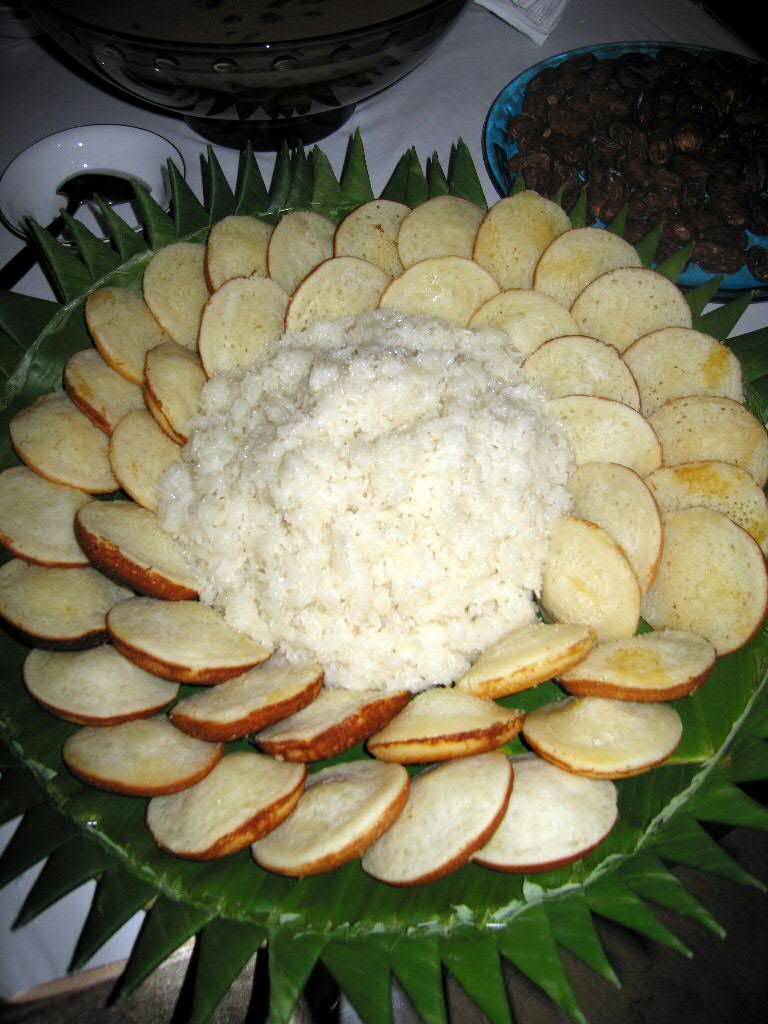
Serabi
Rice flour pancake from Java and Bali, often served with coconut sugar syrup
Serabi is a traditional Indonesian snack from Java and Bali, made from rice flour and coconut milk or cream, cooked like a small pancake. Most are sweet and served with a coconut sugar syrup called kinca, though savoury versions with toppings like fermented oncom exist. Each region has its own style and toppings, and serabi is often part of local rituals.
- Made from rice flour and coconut milk or cream
- Most often served with coconut sugar syrup (kinca)
- Savory versions use toppings like fermented oncom
- Bandung and Solo are famous for their unique serabi styles
- Used in Javanese and Balinese ritual offerings
What is Serabi?
Serabi is a small, round pancake made from a batter of rice flour and coconut milk or cream, sometimes with shredded coconut mixed in. The texture can range from soft and moist to crisp at the edges, depending on the region and cooking style. Most versions are sweet, often topped or served with a syrup made from coconut sugar, which gives a golden color and rich flavor. Some are savoury, with toppings like fermented oncom (a local soybean product), cheese, or even meat. The pancake is usually cooked over charcoal in a small earthenware pan, giving it a subtle smoky aroma.
Where does Serabi come from?
Serabi comes from Java, Indonesia, and has spread to Bali and neighboring regions, including Malaysia. Its exact origins are unknown, but it has long been part of local traditions and rituals. In Javanese folk religion, serabi is used as an offering to express gratitude to gods or local deities. The snack became known as 'Javaans pannenkoek' (Javanese pancake) during Dutch colonial times, a name still used by Javanese communities in Suriname. The spread to Bali is linked to Javanese migration during the Majapahit era, when it was adopted into Balinese Hindu rituals.
How is Serabi made?
To make serabi, rice flour is mixed with coconut milk or cream, sometimes with shredded coconut for texture. The batter may be colored or scented with pandan leaf juice. It is poured into a small clay or metal pan and cooked over charcoal, which creates a crisp edge and soft center. Toppings can be added before or after cooking, ranging from coconut sugar syrup to grated coconut, peanuts, fruit, or savoury items like oncom or cheese. Modern versions may use wheat flour or add unusual toppings like ice cream or mayonnaise.


How and when is Serabi eaten?
Serabi is usually eaten as a snack, sometimes as a breakfast or with tea. It is often enjoyed fresh and warm, sometimes with a drizzle of coconut sugar syrup or coconut milk. In some regions, it is served in a bowl of sweet coconut milk soup or with a pudding. Serabi is also prepared for religious or community rituals, where it is offered to deities or shared among villagers. It can be found at markets, street stalls, and in homes, and is popular for its simple ingredients and comforting taste.
Kinds of Serabi
Each region in Indonesia has its own style of serabi. Bandung's surabi is drier and firmer, with many modern toppings like cheese or chocolate. Solo's serabi is half-cooked, resulting in a crispy edge and a soft, almost runny center, with a strong coconut flavor. Ambarawa serves serabi in a sweet coconut milk soup, while Semarang combines it with a pudding in a dish called bubur serabi. Toppings and sauces have expanded to include everything from peanuts and fruit to mayonnaise and ice cream.
What Serabi means
Serabi holds a special place in Javanese and Balinese culture, especially as a ritual food. It is used in offerings during religious ceremonies and village festivals, symbolizing gratitude and community. The snack is also a point of regional pride, with cities like Bandung and Solo known for their distinctive versions. Its continued popularity at street stalls and markets shows its role as both a daily treat and a food with deep cultural roots.
Questions people ask about Serabi
What is serabi made of?
Serabi is made from a batter of rice flour and coconut milk or cream, sometimes with shredded coconut. It is usually cooked on a small pan over charcoal and served with coconut sugar syrup or other toppings.
Where does serabi come from?
Serabi originated in Java, Indonesia, and is also popular in Bali and Malaysia. It has a long history in Javanese and Balinese culture and is often part of local rituals.
Is serabi always sweet?
Most traditional serabi are sweet and served with coconut sugar syrup, but savoury versions exist, especially those topped with fermented oncom or other ingredients like cheese or meat.
How is serabi served?
Serabi is typically served as a snack, often warm and topped with coconut sugar syrup. In some regions, it is served in coconut milk soup or with pudding, and can be found at street stalls or during festivals.
Are there different types of serabi?
Yes, each region has its own style and toppings. Bandung's version is drier and firmer, while Solo's is half-cooked with a soft center. Toppings range from traditional coconut sugar to modern choices like cheese or ice cream.
Good reading and sources
The facts on this page come from the Wikipedia article "Serabi", written by its contributors and used under the CC BY-SA 4.0 licence, and from its Wikidata record (CC0). Thali rewrote the text in its own words, with AI assistance, and compares every page with the article to make sure no passage is copied. It may be reused under the same CC BY-SA 4.0 licence with a link back.
It may contain mistakes, and it is not dietary or allergy advice: recipes differ from cook to cook. If something is wrong, tell us. Last refreshed 2026-10-03.
More from Indonesia
All the food of Indonesia BreadfruitVegan
🇵🇭 Philippines and 4 moreLarge tropical fruit cooked as a starchy staple in many island cuisines
Main dish, Lunch, Dinner
BreadfruitVegan
🇵🇭 Philippines and 4 moreLarge tropical fruit cooked as a starchy staple in many island cuisines
Main dish, Lunch, Dinner
 Roti canaiரொட்டி சென்னை
🇲🇾 Malaysia and 5 moreUnleavened flatbread tossed thin and cooked until crisp, served with curry or dal
Bread, Breakfast, Snacks
Roti canaiரொட்டி சென்னை
🇲🇾 Malaysia and 5 moreUnleavened flatbread tossed thin and cooked until crisp, served with curry or dal
Bread, Breakfast, Snacks
 Fried rice
🇨🇳 China and 5 moreCooked rice stir-fried with eggs, vegetables, meat or seafood, and seasonings
Main dish, Breakfast, Lunch
Fried rice
🇨🇳 China and 5 moreCooked rice stir-fried with eggs, vegetables, meat or seafood, and seasonings
Main dish, Breakfast, Lunch
Its cousins elsewhere
All sweets and desserts Mofo gasyVegan
🇲🇬 MadagascarSweet rice flour cakes cooked in a mold, eaten for breakfast in Madagascar
Bread, Breakfast
Mofo gasyVegan
🇲🇬 MadagascarSweet rice flour cakes cooked in a mold, eaten for breakfast in Madagascar
Bread, Breakfast
 PamonhaVegetarian
🇧🇷 Brazil and 1 moreSweet corn paste boiled in corn husks, a specialty from Brazil
Sweet or dessert, Snacks
PamonhaVegetarian
🇧🇷 Brazil and 1 moreSweet corn paste boiled in corn husks, a specialty from Brazil
Sweet or dessert, Snacks
 CocadaVegetarian
🇧🇷 Brazil and 5 moreChewy coconut sweets baked and served at room temperature
Sweet or dessert, Snacks
CocadaVegetarian
🇧🇷 Brazil and 5 moreChewy coconut sweets baked and served at room temperature
Sweet or dessert, Snacks
 KobaVegan
🇲🇬 MadagascarA Malagasy sweet cake of peanuts, sugar and rice flour wrapped in banana leaves
Sweet or dessert, Snacks
KobaVegan
🇲🇬 MadagascarA Malagasy sweet cake of peanuts, sugar and rice flour wrapped in banana leaves
Sweet or dessert, Snacks