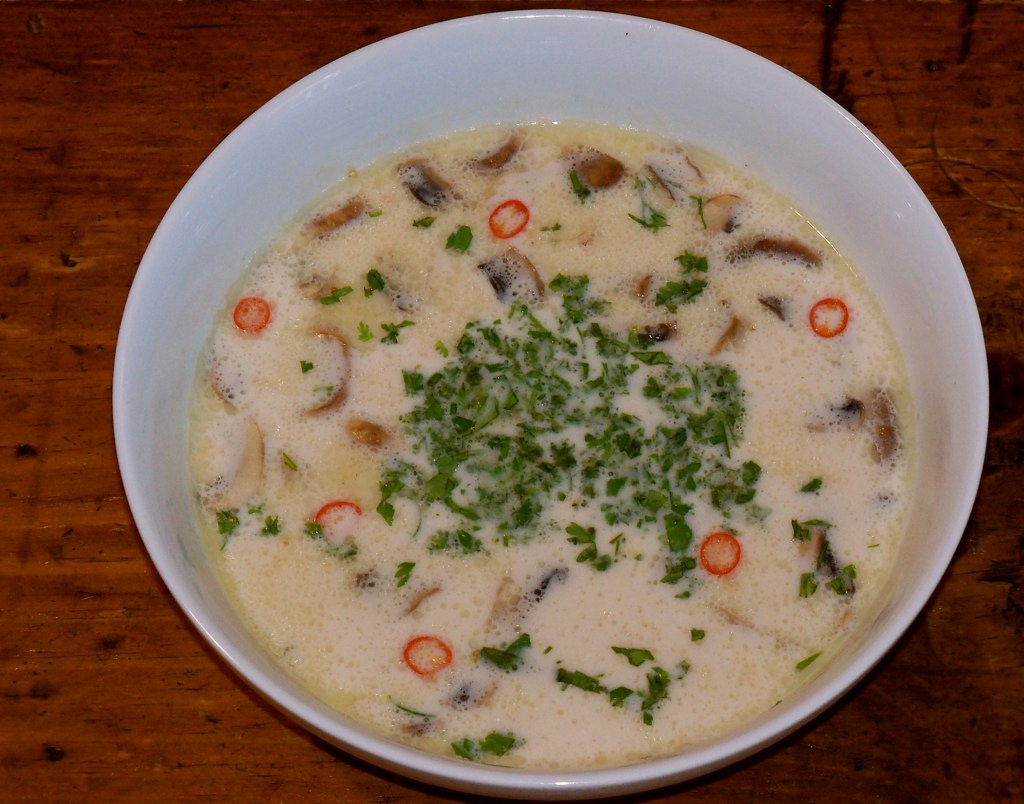
Tom kha kai
In its own language: ต้มข่าไก่
Thai chicken soup with coconut milk, galangal, lemongrass and mushrooms
Tom kha kai is a Thai soup built on coconut milk, chicken, galangal root, lemongrass, and mushrooms. The soup is known for its creamy texture and a balance of spicy, sour, and sweet flavors. It is usually served hot and eaten as part of a meal in Thailand.
- Coconut milk gives the soup its creamy texture
- Galangal root is a key flavor, different from ginger
- First recorded in Thailand in the late 1800s
- Chicken is the most common protein, but shrimp and pork are also used
- Served hot and usually eaten with rice
What is Tom kha kai?
Tom kha kai is a soup from Thailand that combines chicken with coconut milk, galangal (a root similar to ginger), lemongrass, kaffir lime leaves, and mushrooms. Thai chilies and lime juice give it a spicy and tangy edge, while fish sauce adds depth. The coconut milk makes the broth creamy and slightly sweet, balancing the heat and sourness. The soup is typically garnished with fresh coriander. Its aroma is fragrant with citrus and herbs, and the taste is a mix of spicy, sour, and sweet.
Where does Tom kha kai come from?
Tom kha originated in Thailand and was first recorded in a cookbook around 1890. The earliest version, called tom kha pet, used duck and young galangal in a coconut milk broth. Over time, chicken became the main protein, leading to the dish now known as tom kha kai. The soup shares many ingredients with tom yam, another Thai soup, but is set apart by its use of coconut milk, which gives it a milder and richer flavor.
How is Tom kha kai made?
To make tom kha kai, chicken is simmered in a broth flavored with slices of galangal, stalks of lemongrass, and kaffir lime leaves. Coconut milk is added to create a creamy base. Mushrooms, usually straw or other types, are included for texture. Thai chilies provide heat, and the soup is seasoned with fish sauce and lime juice for a balance of salty and sour. Sometimes, fried chilies are added for extra spice, and coriander leaves are used as a garnish.


How and when is Tom kha kai eaten?
Tom kha kai is usually served hot as part of a meal, often at lunch or dinner. It can be eaten on its own or with rice. The soup is enjoyed for its creamy and tangy taste, and it is a common everyday dish in Thailand. Diners often adjust the seasoning at the table with extra lime or chilies, according to personal taste.
Kinds of Tom kha kai
There are several versions of tom kha. Tom kha kung uses shrimp instead of chicken. Other types include tom kha thale with seafood, tom kha het with mushrooms, tom kha mu with pork, and tom kha taohu with tofu. These variations keep the same aromatic broth but change the main protein or use only mushrooms for a vegetarian option.
What Tom kha kai means
Tom kha kai is a familiar part of Thai cuisine and is often found in homes and restaurants across Thailand. Its creamy, aromatic broth makes it distinct from other Thai soups. The dish is not tied to any particular festival or religious event but is valued as a comforting, everyday food. It is also recognized internationally as a classic example of Thai cooking.
Questions people ask about Tom kha kai
What is tom kha kai made of?
Tom kha kai is made with coconut milk, chicken, galangal, lemongrass, kaffir lime leaves, mushrooms, Thai chilies, fish sauce, and lime juice. Coriander is often used as a garnish.
Where does tom kha kai come from?
Tom kha kai comes from Thailand. It was first recorded in a Thai cookbook around 1890 and has become a staple of Thai cuisine.
What does tom kha kai taste like?
The soup has a creamy, slightly sweet broth from coconut milk, balanced by the sharpness of lime and the heat of Thai chilies. Galangal and lemongrass give it a citrusy, herbal aroma.
Are there vegetarian versions of tom kha kai?
Yes, there is a version called tom kha het that uses mushrooms instead of meat. Another variation, tom kha taohu, uses tofu.
How is tom kha kai usually served?
It is served hot, often as part of a meal with rice. Diners may adjust the flavor with extra lime or chilies at the table.
Good reading and sources
The facts on this page come from the Wikipedia article "Tom kha kai", written by its contributors and used under the CC BY-SA 4.0 licence, and from its Wikidata record (CC0). Thali rewrote the text in its own words, with AI assistance, and compares every page with the article to make sure no passage is copied. It may be reused under the same CC BY-SA 4.0 licence with a link back.
It may contain mistakes, and it is not dietary or allergy advice: recipes differ from cook to cook. If something is wrong, tell us. Last refreshed 2026-10-03.
More from Thailand
All the food of Thailand Roti canaiரொட்டி சென்னை
🇲🇾 Malaysia and 5 moreUnleavened flatbread tossed thin and cooked until crisp, served with curry or dal
Bread, Breakfast, Snacks
Roti canaiரொட்டி சென்னை
🇲🇾 Malaysia and 5 moreUnleavened flatbread tossed thin and cooked until crisp, served with curry or dal
Bread, Breakfast, Snacks
 KabochaVeganカボチャ
🇯🇵 Japan and 5 moreA sweet, dense winter squash with edible skin, used in Japanese and Asian cooking
Main dish, Lunch, Dinner
KabochaVeganカボチャ
🇯🇵 Japan and 5 moreA sweet, dense winter squash with edible skin, used in Japanese and Asian cooking
Main dish, Lunch, Dinner
 Thingyan riceFish or seafoodသင်္ကြန်ထမင်း
🇲🇲 Myanmar and 1 moreRice in scented water, served cold with fried dried fish for the Burmese New Year
Main dish, Lunch, Dinner
Thingyan riceFish or seafoodသင်္ကြန်ထမင်း
🇲🇲 Myanmar and 1 moreRice in scented water, served cold with fried dried fish for the Burmese New Year
Main dish, Lunch, Dinner
Its cousins elsewhere
All soups Chicken soupMeat
🇺🇸 United States and 4 moreA hot soup of chicken simmered with vegetables, noodles or grains
Soup, Lunch, Dinner
Chicken soupMeat
🇺🇸 United States and 4 moreA hot soup of chicken simmered with vegetables, noodles or grains
Soup, Lunch, Dinner
 Pot-au-feu
🇫🇷 FranceFrench boiled meat and vegetable stew served in two courses
Stew or curry, Lunch, Dinner
Pot-au-feu
🇫🇷 FranceFrench boiled meat and vegetable stew served in two courses
Stew or curry, Lunch, Dinner
 Waterzooi
🇧🇪 BelgiumBelgian stew of fish or chicken with vegetables in a creamy broth
Stew or curry, Lunch, Dinner
Waterzooi
🇧🇪 BelgiumBelgian stew of fish or chicken with vegetables in a creamy broth
Stew or curry, Lunch, Dinner
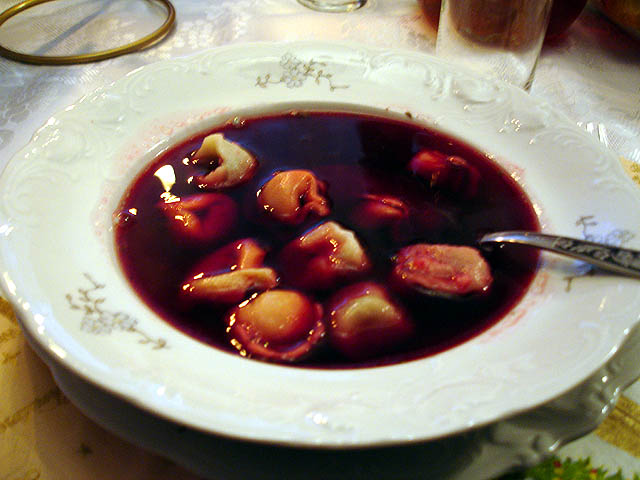 Uszka
🇵🇱 Poland and 2 moreSmall twisted dumplings filled with mushrooms or meat, often served in borscht
Dumpling, Dinner
Uszka
🇵🇱 Poland and 2 moreSmall twisted dumplings filled with mushrooms or meat, often served in borscht
Dumpling, Dinner