Daily meals and habits
Menú del día
The fixed-price weekday lunch offered across Spain: a first course, a second course, bread, a drink and dessert or coffee.
Presented by ClearTrust Free for cooks, travellers and the curious.
The menú del día, the menu of the day, is how working Spain eats lunch. Almost every ordinary restaurant and bar offers one from Monday to Friday. For one modest price you get two courses, bread, a drink and dessert or coffee. It is the best value in Spanish eating and a daily lesson in home-style cooking.

What it is
The menu offers three or four choices for each course. The first course, the primero, is the lighter one: a salad, a soup, lentils or beans, vegetables, rice or pasta. The second, the segundo, is meat or fish, commonly grilled or stewed, with potatoes or salad. Dessert is fruit, yoghurt, custard, rice pudding or a slice of cake, and can often be swapped for coffee. A glass of wine, beer, water or a soft drink is included, and so is bread.
Where it comes from
Set lunches for workers are old in Spain. One common account ties the modern form to the 1960s, when the government required restaurants to offer a fixed-price tourist menu so that visitors would know what a meal cost. The obligation has long gone, but the habit suited the Spanish working day, with its long midday break, and it stayed. Certain dishes have their days. Many places serve paella on Thursdays and a chickpea stew midweek.
How it works
Lunch is served from about half past one to four. The menu is written on a blackboard by the door or recited by the waiter, and is often not on the printed card, so you may need to ask for it. You choose one first and one second course at the start, and dessert later. It is usually offered only at lunch and only on weekdays. Weekend menus cost more. In some bars the price is higher on the terrace.
How to do it
- Look for a board outside that says menú del día and a price.
- Sit down between half past one and three thirty.
- Ask ¿Tienen menú del día? if no one mentions it.
- Choose one primero and one segundo, and say what you will drink.
- Pick dessert or coffee when the plates are cleared.
Good manners
- Each person orders their own menu. Sharing one between two is not accepted.
- Do not ask for many changes. The price depends on the kitchen cooking in bulk.
- A small tip of loose change is plenty.
What is eaten
 Lentil soupA hearty soup made from lentils, often with vegetables and spices
 PaellaRice cooked with meat, seafood or vegetables in a wide shallow pan from Valencia
 GazpachoChilled soup of blended raw vegetables, served cold in Spain and Portugal
 Cocido madrileñoChickpea stew from Madrid, served in separate courses
 Fabada asturianaAsturian white bean stew with pork and sausage
 Olivier saladA Russian salad of diced vegetables, meat and mayonnaise, served at festive meals
 Crème caramelCustard dessert topped with a layer of liquid caramel
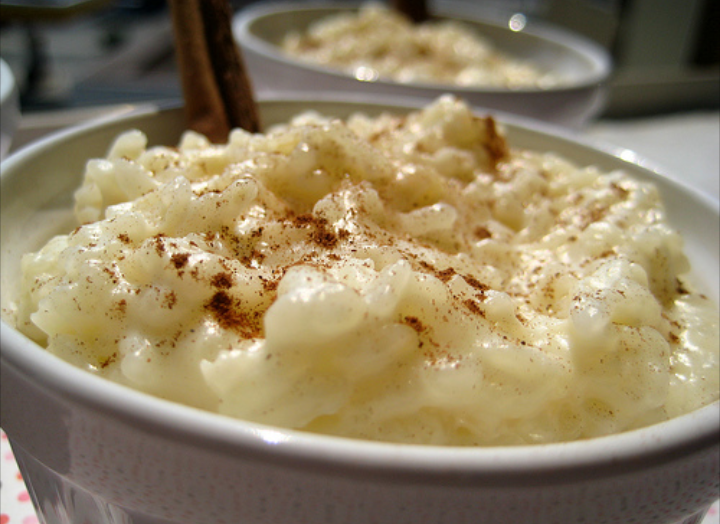 Rice puddingSweetened rice cooked in milk, found in many forms worldwide
 Spanish omeletteEgg and potato omelette, often served as a tapa in Spain
Sources and further reading
Original text by the Thali desk, written with AI assistance and checked against the sources above. Customs vary from place to place. If we have something wrong, tell us.
Photo credits on this page
The small pictures above come from Wikimedia Commons under free licences. Some are cropped to fit.
- Olivier salad: Jacek Halicki, CC BY-SA 4.0, source
- Cocido madrileño: Tnarik, CC BY-SA 2.0, source
- Paella: Jebulon, CC0, source
- Spanish omelette: Tamorlan, CC BY-SA 3.0, source
- Rice pudding: Eli123seo, CC BY-SA 4.0, source
- Gazpacho: Bocadorada, CC BY-SA 2.0, source
- Fabada asturiana: Amasuela, Luis Lafuente Agudín, CC BY-SA 4.0, source
- Crème caramel: Amanda Coutinho, CC BY 2.0, source
- Lentil soup: Burkhard Mücke, CC BY 4.0, source