
Grits
A warm porridge made from ground corn, central to Southern U.S. cooking
Grits is a porridge from the United States made by simmering coarsely ground dried corn or hominy in water or milk. It is most often eaten in the South, served as a breakfast side or as part of dishes like shrimp and grits. Grits can be savory or sweet, but savory versions are more common.
- Made from coarsely ground corn or hominy
- Most popular in the Southern United States
- Georgia named grits its official prepared food in 2002
- Can be served with shrimp, fish, or eggs
- Comes in white, yellow, and other natural corn colors
What is Grits?
Grits is a thick, creamy porridge made by simmering coarsely ground corn or hominy in water or milk. Hominy is corn that has been treated with an alkali to remove its outer layer. The finished dish is smooth, with a mild corn flavor, and can be white, yellow, or even red or blue, depending on the corn used. Grits are usually served hot, often as a side with eggs, bacon, or meat, but can also be the base for main dishes.
Where does Grits come from?
Grits began with the Muscogee people, who made a similar dish from maize. European settlers learned the method from Native Americans, and it became a staple in the American South. Traditionally, grits were made by grinding corn on stone mills. The dish spread across the Southern states, and today most grits in the U.S. are eaten in the South, an area sometimes called the 'grits belt.' Georgia named grits its official prepared food in 2002.
How is Grits made?
To make grits, ground corn or hominy is slowly stirred into hot water or milk and cooked until soft and thick. Salt is usually added. There are different types: stone-ground grits take longer to cook and have more texture, while 'quick' grits are finer and cook faster. Once cooked, grits can be eaten as is or cooled until firm, then sliced and fried.
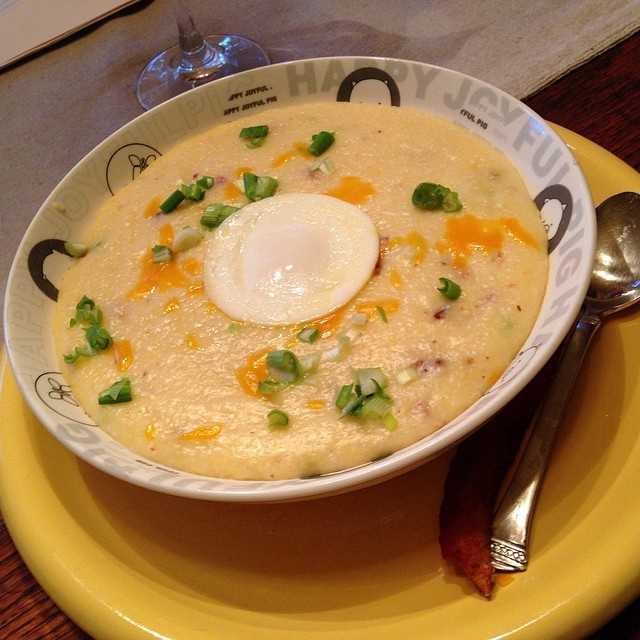


How and when is Grits eaten?
Grits are most often served for breakfast in the Southern United States, paired with eggs, bacon, or toast. They can also be part of lunch or dinner, especially when topped with meats like shrimp, ham, or fried fish. In some places, grits are served sweet, but savory versions with cheese or butter are more common. Solidified grits can be fried for a different texture.
Kinds of Grits
There are several types of grits, including hominy grits, cheese grits, and fried grits. Grits can be made from white, yellow, or even colored corn. 'Shrimp and grits' is a well-known main dish in coastal South Carolina and Georgia. In Florida, 'grits and grunts' pairs grits with fried fish. Stone-ground grits are less processed and have a coarser texture.
What Grits means
Grits are closely linked to Southern identity and daily life. Georgia declared it the official prepared food of the state, and South Carolina has laws regulating grits and cornmeal. The dish is a symbol of Southern hospitality and tradition, and it appears in both everyday meals and regional specialties. Its connection to Native American and Southern heritage is widely recognized.
Questions people ask about Grits
What are grits made of?
Grits are made from coarsely ground dried corn or hominy, which is corn treated with an alkali to remove the outer layer. They are cooked with water or milk and usually seasoned with salt.
Where do grits come from?
Grits originated in the Southern United States, based on a dish made by the Muscogee Native Americans. The method was adopted by European settlers and became a staple in Southern cooking.
Are grits sweet or savory?
Grits can be served either way, but savory versions are more common. They are often flavored with cheese, butter, or served with meats like shrimp, bacon, or ham.
How are grits usually eaten?
Grits are most often eaten hot for breakfast, but can also be served at lunch or dinner, sometimes as a side or as a main dish topped with shrimp, fried fish, or eggs.
What is the difference between grits and polenta?
Both are maize-based porridges, but grits are made from corn or hominy and are a staple in the Southern United States, while polenta is Italian and made from yellow cornmeal. The texture and flavor can differ.
Good reading and sources
The facts on this page come from the Wikipedia article "Grits", written by its contributors and used under the CC BY-SA 4.0 licence, and from its Wikidata record (CC0). Thali rewrote the text in its own words, with AI assistance, and compares every page with the article to make sure no passage is copied. It may be reused under the same CC BY-SA 4.0 licence with a link back.
It may contain mistakes, and it is not dietary or allergy advice: recipes differ from cook to cook. If something is wrong, tell us. Last refreshed 2026-10-03.
More from the United States
All the food of the United States Pizza
🇮🇹 Italy and 4 moreFlatbread topped with tomato, cheese and baked at high heat
Main dish, Lunch, Dinner
Pizza
🇮🇹 Italy and 4 moreFlatbread topped with tomato, cheese and baked at high heat
Main dish, Lunch, Dinner
 HamburgerMeat
🇺🇸 United States and 1 moreA hot ground meat patty in a sliced bun, often with salad and sauces
Main dish, Lunch, Dinner
HamburgerMeat
🇺🇸 United States and 1 moreA hot ground meat patty in a sliced bun, often with salad and sauces
Main dish, Lunch, Dinner
 SpaghettiVegan
🇮🇹 Italy and 2 moreLong, thin pasta strands made from durum wheat and water
Noodle or pasta dish, Lunch, Dinner
SpaghettiVegan
🇮🇹 Italy and 2 moreLong, thin pasta strands made from durum wheat and water
Noodle or pasta dish, Lunch, Dinner
 Hot dogMeat
🇺🇸 United States and 2 moreA sausage in a sliced bun, topped with condiments and eaten hot
Street food, Lunch, Dinner
Hot dogMeat
🇺🇸 United States and 2 moreA sausage in a sliced bun, topped with condiments and eaten hot
Street food, Lunch, Dinner
Its cousins elsewhere
All main dishes Dampfnudel
🇩🇪 Germany and 3 moreSoft yeast dumplings cooked in a covered pan until golden underneath
Dumpling, Lunch, Dinner
Dampfnudel
🇩🇪 Germany and 3 moreSoft yeast dumplings cooked in a covered pan until golden underneath
Dumpling, Lunch, Dinner
 Cachapa
🇻🇪 VenezuelaVenezuelan corn pancakes often filled with cheese and served hot
Main dish, Breakfast, Snacks
Cachapa
🇻🇪 VenezuelaVenezuelan corn pancakes often filled with cheese and served hot
Main dish, Breakfast, Snacks
 Crêpe
🇫🇷 FranceThin French pancakes, served sweet or savoury with a range of fillings
Main dish, Breakfast, Lunch
Crêpe
🇫🇷 FranceThin French pancakes, served sweet or savoury with a range of fillings
Main dish, Breakfast, Lunch
 ChapatiVeganचपाती
🇮🇳 India and 4 moreUnleavened flatbread cooked on a griddle and served hot with meals
Bread, Breakfast, Lunch
ChapatiVeganचपाती
🇮🇳 India and 4 moreUnleavened flatbread cooked on a griddle and served hot with meals
Bread, Breakfast, Lunch