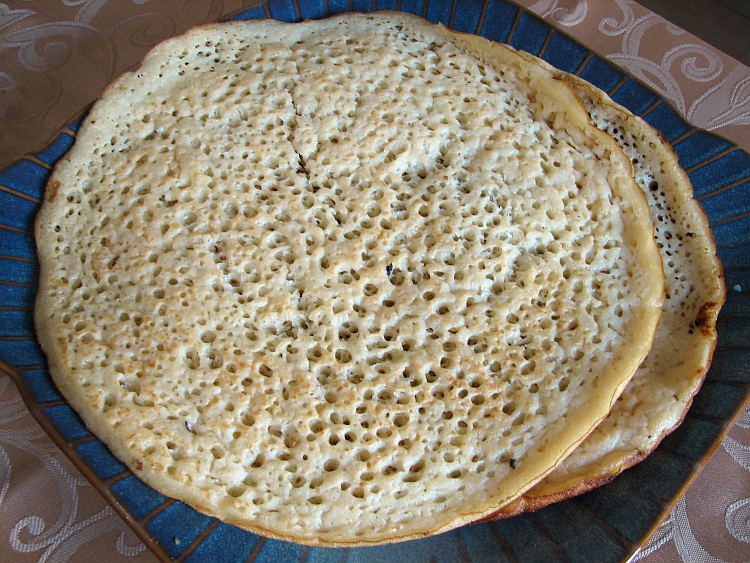
Lahoh
In its own language: لحوح
Spongy fermented flatbread baked into soft, airy rounds
Lahoh is a spongy, bubbly flatbread native to Somalia and widely enjoyed across the Horn of Africa and Yemen. Whisked from a fermented grain batter, it is commonly served warm at breakfast alongside spiced tea, honey, or savoury meat dishes.
- Cooked on one side to produce a tender crumb filled with tiny air pockets
- Made traditionally with sorghum flour fermented overnight for a gentle sour taste
- Somali cooks prepare a spiced holiday version called cambaabur for Eid breakfast
- Brought to Israel by Yemenite Jewish immigrants, where it became a widely eaten staple
What is Lahoh?
Lahoh is a thin, tender flatbread marked by a porous, cratered surface much like a thick crepe or pancake. Bakers commonly make it from sorghum meal mixed with white cornmeal or wheat flour, water, yeast, and salt. Hand beating turns the mixture smooth and light before an overnight rise gives it a gentle tang. Cooked on one side, it stays pale and flexible, with a springy bite that absorbs toppings and broth easily.
Where does Lahoh come from?
Originating in the Horn of Africa and historically rooted in Somali cuisine, the bread has long been a staple throughout Somalia, Somaliland, Djibouti, and parts of Kenya and Ethiopia. It also holds deep roots across the Red Sea in Yemen, where cooks evolved their own traditions. During the twentieth century, Yemenite Jewish communities introduced the griddled flatbread to Israel, where it gained broad popularity in neighborhood bakeries.
How is Lahoh made?
Bakers blend flour with warm water, salt, and yeast, whipping the batter by hand until velvety. Traditionally, cooks in Somalia used a cooked sorghum starter called cajiin or preserved batter known as dhanaanis to trigger fermentation. In Yemen, an initial flour slurry called sharaba begins the batch. Once fermented and gently bubbly, spoonfuls of batter are poured onto a hot circular stove called a dhaawe, a curved griddle, or a lidded skillet until set.


How and when is Lahoh eaten?
Across Somalia and Djibouti, the flatbread anchors the morning table with hot Somali tea. Diners drizzle the warm rounds with clarified butter called subag, sesame oil, honey, or olive oil. It also pairs with savoury morning sides such as suqaar stir-fried meat, spiced liver, or dried meat. At midday, it accompanies rich curries and stews. In Yemen, cooks crumble it into the cold yoghurt dish shafuta, eat it with saltah, or pair it with spicy zhug relish.
Kinds of Lahoh
Regional styles alter both texture and pattern. Somali versions often feature a delicate poured swirl and can be flavored with spices, sugar, or egg. For Eid celebrations, Somalis bake a spiced festive variation known as cambaabur. Yemeni bakers favor white sorghum and rarely add the Somali spiral. Near Tais, the village of Aruuq produces lahoh Ariiqy, an extra-large version baked on a saj griddle with bold zebra-like scorch marks.
What Lahoh means
Lahoh forms the heartbeat of everyday morning hospitality in the Horn of Africa and southwestern Arabia. In Yemeni culture, the bread is cherished as a celebratory pancake and features centrally in feast spreads. The flatbread also crossed cultural borders through Yemenite Jewish migration, becoming a beloved comfort food in Israeli street stalls and home kitchens.
Questions people ask about Lahoh
What is lahoh made of?
Lahoh is prepared from a runny batter of flour, warm water, salt, and yeast. Sorghum flour is the traditional choice, often blended with cornmeal or wheat flour and left to ferment overnight.
Where did lahoh originate?
The bread originated in Somalia and the wider Horn of Africa. It also developed deep historic roots across the Red Sea in Yemeni cooking.
How is lahoh typically eaten?
It is usually served at breakfast with Somali tea, sweetened with honey and clarified butter, or paired with meats like liver and suqaar. In Yemen, it often features in yoghurt appetizers or stews.
What is cambaabur?
Cambaabur is a spiced, festive Somali variation of lahoh. It is seasoned with aromatic spices and traditionally served for breakfast during the Muslim holiday of Eid.
Good reading and sources
The facts on this page come from the Wikipedia article "Lahoh", written by its contributors and used under the CC BY-SA 4.0 licence, and from its Wikidata record (CC0). EveryThali rewrote the text in its own words, with AI assistance, and compares every page with the article to make sure no passage is copied. It may be reused under the same CC BY-SA 4.0 licence with a link back.
It may contain mistakes, and it is not dietary or allergy advice: recipes differ from cook to cook. If something is wrong, tell us. Last refreshed 2026-10-04.
More from Somalia
All the food of Somalia MandaziVegetarian
🇹🇿 Tanzania and 4 moreFluffy fried bread from the Swahili coast, gently sweetened and cut into triangles
Bread, Breakfast, Snacks
Halvaحَلَاوَة
🇮🇷 Iran and 5 moreDense sweet made from seeds, grains, or vegetables, found across Asia, Africa, and Europe
Sweet or dessert, Snacks, Tea time
MandaziVegetarian
🇹🇿 Tanzania and 4 moreFluffy fried bread from the Swahili coast, gently sweetened and cut into triangles
Bread, Breakfast, Snacks
Halvaحَلَاوَة
🇮🇷 Iran and 5 moreDense sweet made from seeds, grains, or vegetables, found across Asia, Africa, and Europe
Sweet or dessert, Snacks, Tea time
 Qamar al-DinVeganقمر الدين
🇸🇾 Syria and 3 moreThick apricot fruit leather and drink, especially served during Ramadan
Drink, Snacks
Qamar al-DinVeganقمر الدين
🇸🇾 Syria and 3 moreThick apricot fruit leather and drink, especially served during Ramadan
Drink, Snacks
Its cousins elsewhere
All breads BaguetteVegan
🇫🇷 France and 5 moreLong, thin French bread with a crisp crust and soft interior
Bread, Breakfast, Lunch
BaguetteVegan
🇫🇷 France and 5 moreLong, thin French bread with a crisp crust and soft interior
Bread, Breakfast, Lunch
 Bagel
🇵🇱 Poland and 2 moreRing-shaped bread roll, boiled then baked for a dense, chewy texture
Bread, Breakfast, Lunch
Bagel
🇵🇱 Poland and 2 moreRing-shaped bread roll, boiled then baked for a dense, chewy texture
Bread, Breakfast, Lunch
 FocacciaVegetarian
🇮🇹 Italy and 1 moreItalian flatbread baked with olive oil and often herbs or salt
Bread, Breakfast, Snacks
FocacciaVegetarian
🇮🇹 Italy and 1 moreItalian flatbread baked with olive oil and often herbs or salt
Bread, Breakfast, Snacks