Lamian
In its own language: 拉麵
Hand-pulled wheat noodles stretched into long strands
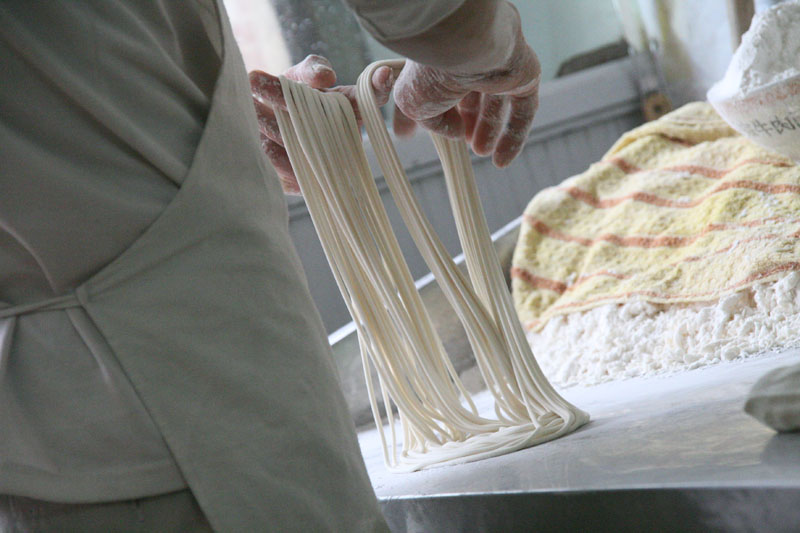
Lamian are Chinese noodles made by stretching and folding wheat dough by hand until it forms long, thin strands. Common in northern China, lamian are served in beef broth, stir-fried, or cold with vegetables. The noodles are a staple in many Chinese cities and are often found in restaurants run by Hui families.
- Lamian are hand-pulled noodles made from wheat flour dough
- The pulling technique was described in a 1504 Ming dynasty manual
- Lanzhou is famous for its beef noodle soup made with lamian
- Most lamian restaurants in China are run by Hui Muslim families
- Lamian is served in soup, stir-fried, or cold with vegetables
What is Lamian?
Lamian are long, soft noodles made from wheat flour dough that is repeatedly stretched and folded by hand. The process creates strands of varying thickness, depending on how many times the dough is pulled. The noodles are typically served in a clear, meat-based broth, often with beef or mutton, and sometimes with vegetables. Lamian can also be stir-fried or served cold with salad-like toppings. The noodles are smooth and chewy, with a fresh wheat aroma.
Where does Lamian come from?
Lamian originated in China, with the earliest known description of the pulling technique found in a 1504 dietary manual from the Ming dynasty. The name comes from Chinese words meaning 'to pull' and 'noodle.' While lamian's hand-pulled method is unique to China, its name has influenced the Japanese word 'ramen' and the Korean 'ramyeon,' though the dishes themselves are different. The tradition of hand-pulling noodles is especially strong in northern China.
How is Lamian made?
To make lamian, a piece of soft wheat dough is stretched, folded, and twisted repeatedly to align the gluten and create long strands. The dough is pulled to arm's length, looped, and doubled several times until the desired thickness and number of noodles is reached. Some makers dust the strands with flour between pulls to prevent sticking. Styles differ: Lanzhou pullers use quick, straight tugs, while Beijing makers twist and wave the dough for extra length.


How and when is Lamian eaten?
Lamian is most often eaten in a hot, beef-flavored broth, sometimes with mutton or vegetables. It can also be stir-fried with sauce or served cold with raw vegetables for a summer meal. In China, lamian is a common everyday food, especially in small restaurants run by Hui families, where it is served halal. The noodles are popular for lunch or dinner and are a staple in many Chinese cities.
Kinds of Lamian
Regional versions include Lanzhou-style, known for its clear beef broth and aggressive pulling technique, and Shandong lamian from Yantai. Lamian may be served as tangmian (in soup), chaomian (stir-fried), or even cold with salad ingredients. Outside China, lamian is found in Chinatowns in the United States and the Philippines, and in some German cities. Each place may adapt the toppings or broth to local tastes.
What Lamian means
Lamian is closely tied to the Hui Muslim community in China, who run many of the noodle shops and serve halal versions. These restaurants are especially common in eastern and western Chinese cities. The hand-pulling technique is sometimes performed as a show, with pullers stretching and twirling the dough in front of customers. Lamian has influenced the names of noodles in Japan and Korea, reflecting its cultural reach.
Questions people ask about Lamian
What is lamian made of?
Lamian is made from wheat flour dough that is stretched and folded by hand into long noodles. The noodles are usually served in a meat-based broth with beef, mutton, or vegetables.
Where does lamian come from?
Lamian originated in China, with a history dating back to at least the Ming dynasty. It is especially common in northern China and in cities like Lanzhou and Beijing.
How are lamian noodles made?
The dough is repeatedly stretched, folded, and twisted by hand to create long, thin strands. The process aligns the gluten and gives the noodles their chewy texture.
How is lamian usually served?
Lamian is most often served in a hot beef or mutton broth, but it can also be stir-fried with sauce or served cold with vegetables.
Are lamian noodles always halal?
Most lamian restaurants in China are run by Hui Muslim families and serve halal food, so pork is not used. However, the noodles themselves can be made in non-halal versions elsewhere.
Good reading and sources
The facts on this page come from the Wikipedia article "Lamian", written by its contributors and used under the CC BY-SA 4.0 licence, and from its Wikidata record (CC0). Thali rewrote the text in its own words, with AI assistance, and compares every page with the article to make sure no passage is copied. It may be reused under the same CC BY-SA 4.0 licence with a link back.
It may contain mistakes, and it is not dietary or allergy advice: recipes differ from cook to cook. If something is wrong, tell us. Last refreshed 2026-10-03.
More from China
All the food of China Pasta
🇮🇹 Italy and 1 moreUnleavened dough shaped and cooked, a staple of Italian cuisine
Main dish, Lunch, Dinner
TofuVegan豆腐
🇨🇳 China and 5 moreSoft white blocks made by curdling soy milk and pressing the curds
Main dish
Pasta
🇮🇹 Italy and 1 moreUnleavened dough shaped and cooked, a staple of Italian cuisine
Main dish, Lunch, Dinner
TofuVegan豆腐
🇨🇳 China and 5 moreSoft white blocks made by curdling soy milk and pressing the curds
Main dish
 RamenMeatラーメン
🇯🇵 Japan and 1 moreJapanese noodle soup with Chinese-style wheat noodles in hot broth
Soup, Lunch, Dinner
RamenMeatラーメン
🇯🇵 Japan and 1 moreJapanese noodle soup with Chinese-style wheat noodles in hot broth
Soup, Lunch, Dinner
 Chuanr串
🇨🇳 ChinaGrilled skewers of meat, seafood or vegetables from northern China
Grill or roast, Dinner, Snacks
Chuanr串
🇨🇳 ChinaGrilled skewers of meat, seafood or vegetables from northern China
Grill or roast, Dinner, Snacks
Its cousins elsewhere
All noodles and pasta RechtaMeatرشتة
🇩🇿 Algeria and 1 moreAlgerian handmade noodles served with chicken and vegetables in a spiced sauce
Main dish, Lunch, Dinner
RechtaMeatرشتة
🇩🇿 Algeria and 1 moreAlgerian handmade noodles served with chicken and vegetables in a spiced sauce
Main dish, Lunch, Dinner
 SpaghettiVegan
🇮🇹 Italy and 2 moreLong, thin pasta strands made from durum wheat and water
Noodle or pasta dish, Lunch, Dinner
SpaghettiVegan
🇮🇹 Italy and 2 moreLong, thin pasta strands made from durum wheat and water
Noodle or pasta dish, Lunch, Dinner
 TortelliniMeat
🇮🇹 ItalySmall ring-shaped pasta parcels filled with seasoned meat and cheese
Main dish, Lunch, Dinner
TortelliniMeat
🇮🇹 ItalySmall ring-shaped pasta parcels filled with seasoned meat and cheese
Main dish, Lunch, Dinner
 SpätzleSpätzla
🇩🇪 Germany and 5 moreIrregular egg noodles from Swabia, served as a side or main dish
Main dish, Lunch, Dinner
SpätzleSpätzla
🇩🇪 Germany and 5 moreIrregular egg noodles from Swabia, served as a side or main dish
Main dish, Lunch, Dinner