
Lupin bean
In its own language: ترمس
Pickled or brined yellow legume seeds eaten as a snack in the Mediterranean and Latin America
Lupin beans are yellow seeds from the Lupinus plant, enjoyed as a pickled snack in the Mediterranean, Latin America, and North Africa. Traditionally, they are soaked to remove bitterness and toxins, then served in brine or as street food. They are also ground into flour for gluten-free baking and used in vegan foods.
- Eaten as a pickled snack in the Mediterranean and Latin America
- Ancient evidence found in Egyptian tombs from the 22nd century BC
- Requires soaking to remove bitter alkaloids in traditional varieties
- Used in gluten-free flour and vegan foods
- Popular street food during Egypt's Sham Ennessim festival
What is Lupin bean?
Lupin beans are yellow seeds from the Lupinus plant, usually eaten after pickling or brining. They have a firm texture and a slightly nutty, earthy taste when properly prepared. The beans are often sold in jars, similar to olives, or by street vendors. To eat them, people may pop the seed from its skin with their teeth or rub off the skin by hand. Lupin beans are also ground into flour for gluten-free baking and used in vegan products.
Where does Lupin bean come from?
Lupin beans have been eaten since ancient times, with evidence from Egyptian tombs dating back to the 22nd century BC. The beans were known to the ancient Greeks and Romans, and a distinct Andean variety was domesticated by pre-Incan peoples in present-day Peru. Today, they are common in the Mediterranean, Latin America, and North Africa, and have spread to Australia and Europe as both a food and animal feed crop.
How is Lupin bean made?
Traditional preparation involves soaking the beans in salted water for several days to remove bitter alkaloids and toxins. Some modern varieties, called sweet lupins, contain fewer alkaloids and can be eaten without extensive soaking. After soaking, the beans are often kept in brine and served cold. In some regions, they are used in salads or as a garnish, while in others, they are a street snack.


How and when is Lupin bean eaten?
Lupin beans are most often eaten as a snack, especially during festivals like Sham Ennessim in Egypt. In France, they are served with drinks or added to salads. In Ecuador, they appear as a street food similar to ceviche. The beans are typically eaten cold, sometimes with the skin removed, and are popular at gatherings or as a casual bite.
Kinds of Lupin bean
There are both bitter and sweet varieties of lupin beans. Bitter types require careful soaking to remove toxins, while sweet types can be eaten more easily. In Australia and parts of Europe, sweet lupins are used for flour, vegan sausages, and tofu-like products. In Ecuador, a local street food called cevichochos uses lupin beans. Mediterranean countries often prefer the traditional bitter beans for their stronger flavor.
What Lupin bean means
Lupin beans are closely tied to Egyptian culture, especially during the Sham Ennessim festival. They are a familiar street food in Egypt and Ecuador. In Europe and Australia, lupin flour is valued for gluten-free baking and as a plant-based protein. The beans must be properly prepared to avoid toxicity, and in the EU, lupin is listed as an allergen due to cross-reactivity with peanuts.
When Lupin bean is on the table
Questions people ask about Lupin bean
What are lupin beans made of?
Lupin beans are the yellow seeds of the Lupinus plant. They are typically prepared by soaking in salted water and then kept in brine, sometimes with the skin removed before eating.
Where do lupin beans come from?
Lupin beans have ancient origins in Egypt and the Mediterranean, and a separate variety was domesticated in the Andes. Today, they are eaten in Mediterranean countries, Latin America, and North Africa.
How are lupin beans eaten?
They are usually eaten as a pickled or brined snack, either by popping the seed from its skin or eating it whole. In Egypt, they are sold by street vendors, and in France, they are served with drinks or in salads.
Are lupin beans safe to eat?
Traditional bitter varieties must be soaked in salted water to remove toxic alkaloids. Modern sweet lupins are safer and can be eaten with less preparation. Improperly prepared beans can cause poisoning.
Are lupin beans suitable for gluten-free or vegan diets?
Yes, lupin beans are naturally gluten-free and vegan. They are used in gluten-free baking, vegan sausages, and other plant-based foods.
Good reading and sources
The facts on this page come from the Wikipedia article "Lupin bean", written by its contributors and used under the CC BY-SA 4.0 licence, and from its Wikidata record (CC0). Thali rewrote the text in its own words, with AI assistance, and compares every page with the article to make sure no passage is copied. It may be reused under the same CC BY-SA 4.0 licence with a link back.
It may contain mistakes, and it is not dietary or allergy advice: recipes differ from cook to cook. If something is wrong, tell us. Last refreshed 2026-10-03.
More from Egypt
All the food of Egypt HummusVegan
🇸🇾 Syria and 5 moreMashed chickpeas blended with tahini, lemon, and garlic, served as a dip or spread
Sauce, pickle or ferment, Breakfast, Lunch
HummusVegan
🇸🇾 Syria and 5 moreMashed chickpeas blended with tahini, lemon, and garlic, served as a dip or spread
Sauce, pickle or ferment, Breakfast, Lunch
 Baba ghanoushVeganبابا غنوج
🇪🇬 Egypt and 5 moreRoasted eggplant mashed with tahini, olive oil, and lemon juice, served as a dip
Salad or side, Snacks
Baba ghanoushVeganبابا غنوج
🇪🇬 Egypt and 5 moreRoasted eggplant mashed with tahini, olive oil, and lemon juice, served as a dip
Salad or side, Snacks
 Strained yogurt
🇬🇷 Greece and 5 moreYogurt thickened by straining out most of its whey
Sauce, pickle or ferment, Breakfast, Snacks
Strained yogurt
🇬🇷 Greece and 5 moreYogurt thickened by straining out most of its whey
Sauce, pickle or ferment, Breakfast, Snacks
Its cousins elsewhere
All sauces, pickles and ferments SauerkrautVegan
🇩🇪 Germany and 5 moreFinely shredded cabbage preserved by natural fermentation in salt
Sauce, pickle or ferment, Lunch, Dinner
SauerkrautVegan
🇩🇪 Germany and 5 moreFinely shredded cabbage preserved by natural fermentation in salt
Sauce, pickle or ferment, Lunch, Dinner
 SurströmmingFish or seafood
🇸🇪 SwedenFermented Baltic herring with a famously strong smell, eaten cold in Sweden
Sauce, pickle or ferment, Dinner
SurströmmingFish or seafood
🇸🇪 SwedenFermented Baltic herring with a famously strong smell, eaten cold in Sweden
Sauce, pickle or ferment, Dinner
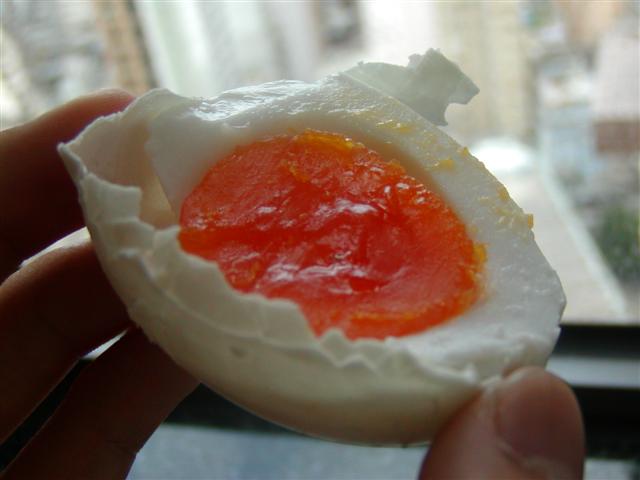 Salted duck egg
🇨🇳 China and 3 moreDuck eggs preserved in salt, prized for their rich, orange-red yolks
Sauce, pickle or ferment, Breakfast, Lunch
Salted duck egg
🇨🇳 China and 3 moreDuck eggs preserved in salt, prized for their rich, orange-red yolks
Sauce, pickle or ferment, Breakfast, Lunch
 HushpuppyVegetarian
🇺🇸 United StatesDeep-fried cornmeal balls often served with seafood in the Southern United States
Sauce, pickle or ferment, Lunch, Dinner
HushpuppyVegetarian
🇺🇸 United StatesDeep-fried cornmeal balls often served with seafood in the Southern United States
Sauce, pickle or ferment, Lunch, Dinner