
Mahdjouba
In its own language: محجوبة
Thin Algerian flatbread with a savoury vegetable filling
Mahdjouba is a thin flatbread from Algeria, made with semolina and flour, and filled with a spiced mixture of tomato, onion, and sometimes other vegetables. Popular across Algeria, especially in the south, it is a common street food and can be served plain or with added ingredients like meat or cheese.
- Mahdjouba is a popular street food across Algeria
- The name means 'veiled' in Algerian Arabic
- It is filled with a spiced mix of tomato, onion, and peppers
- Regional versions may include meat or cheese
- It is related to the North African flatbread m'semen
What is Mahdjouba?
Mahdjouba is a thin, pliable flatbread made from a dough of semolina and flour. The bread is filled with a cooked mixture of tomatoes, onions, peppers, garlic, and spices, then folded to enclose the filling. The outside is golden and slightly crisp, while the inside holds a soft, savoury vegetable mixture. It is often enjoyed as a snack or meal, and is a familiar sight at street stalls across Algeria.
Where does Mahdjouba come from?
This dish comes from Algeria, with roots in the southern cities such as Biskra and Touggourt. The name means 'veiled' or 'covered' in Algerian Arabic, referring to the way the filling is hidden inside the dough. Mahdjouba is related to m'semen, a North African flatbread, but differs by having a vegetable filling. Over time, it has become popular throughout the country, especially as a quick street food.
How is Mahdjouba made?
To prepare mahdjouba, a dough is made using semolina and flour, kneaded until smooth and elastic. The filling is cooked separately, combining tomatoes, onions, peppers, garlic, and spices until soft and fragrant. The dough is rolled out thin, the filling is placed in the center, and the dough is folded over to seal it. The filled breads are then cooked on a hot griddle or pan until both sides are browned.

How and when is Mahdjouba eaten?
Mahdjouba is commonly eaten hot or warm, either as a main meal or a snack. It is popular at lunchtime or in the evening, often sold by street vendors. Some people enjoy it with a glass of mint tea. The flatbread can be eaten on its own or paired with salads or other small dishes. It is a staple of everyday eating in Algeria.
Kinds of Mahdjouba
While the classic mahdjouba uses a vegetable filling, some regions add meat or chicken for a heartier version. In other areas, cheese is included with the vegetables. The basic dough and method remain the same, but the filling can change to suit local tastes or available ingredients. These variations allow mahdjouba to be adapted for different diets and preferences.
What Mahdjouba means
Mahdjouba is a key part of Algerian street food culture and is enjoyed by people of all ages. Its simple ingredients and satisfying taste have made it a daily staple, especially in southern Algeria. The dish is also a symbol of hospitality and is often served to guests. Its connection to m'semen links it to broader North African food traditions.
Questions people ask about Mahdjouba
What is mahdjouba made of?
Mahdjouba is made from a dough of semolina and flour, filled with a cooked mixture of tomato, onion, pepper, garlic, and spices. Some versions also include meat or cheese.
Where does mahdjouba come from?
Mahdjouba originates in Algeria, especially in the southern cities like Biskra and Touggourt. It is now enjoyed throughout the country.
Is mahdjouba vegetarian?
The traditional version is vegetarian, using only vegetables and spices. However, some regional recipes include meat, chicken, or cheese, so it can vary.
How is mahdjouba served?
It is usually served hot or warm, often as a snack or meal. Mahdjouba is commonly sold by street vendors and sometimes enjoyed with mint tea.
What is the difference between mahdjouba and m'semen?
Both are North African flatbreads, but mahdjouba is filled with vegetables, while m'semen is usually plain.
Good reading and sources
The facts on this page come from the Wikipedia article "Mahdjouba", written by its contributors and used under the CC BY-SA 4.0 licence, and from its Wikidata record (CC0). Thali rewrote the text in its own words, with AI assistance, and compares every page with the article to make sure no passage is copied. It may be reused under the same CC BY-SA 4.0 licence with a link back.
It may contain mistakes, and it is not dietary or allergy advice: recipes differ from cook to cook. If something is wrong, tell us. Last refreshed 2026-10-03.
More from Algeria
All the food of Algeria BaguetteVegan
🇫🇷 France and 5 moreLong, thin French bread with a crisp crust and soft interior
Bread, Breakfast, Lunch
BaguetteVegan
🇫🇷 France and 5 moreLong, thin French bread with a crisp crust and soft interior
Bread, Breakfast, Lunch
 Börek
🇹🇷 Turkey and 5 moreFlaky pastry filled with cheese, meat or vegetables, baked or fried
Pie or savoury pastry, Breakfast, Lunch
Börek
🇹🇷 Turkey and 5 moreFlaky pastry filled with cheese, meat or vegetables, baked or fried
Pie or savoury pastry, Breakfast, Lunch
 BaghrirVegetarianالبغرير
🇩🇿 Algeria and 2 moreSpongy semolina pancakes from the Maghreb, full of tiny holes for soaking up sauces
Bread, Breakfast, Snacks
BaghrirVegetarianالبغرير
🇩🇿 Algeria and 2 moreSpongy semolina pancakes from the Maghreb, full of tiny holes for soaking up sauces
Bread, Breakfast, Snacks
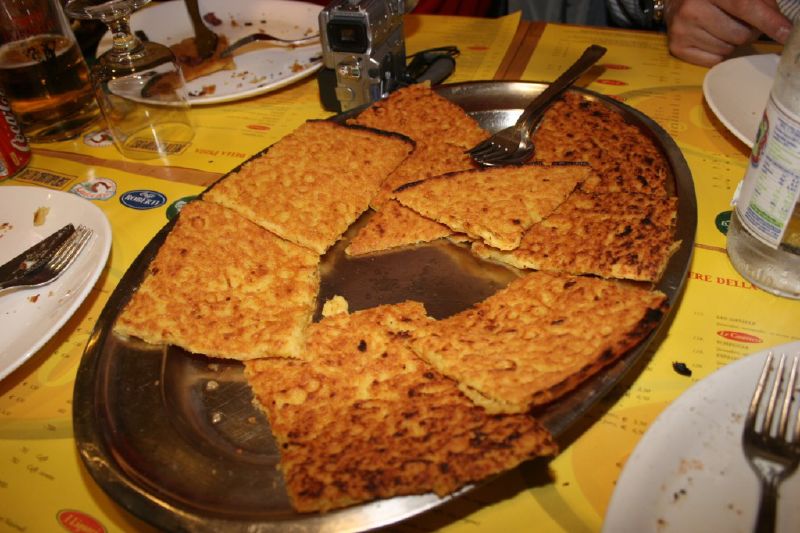 FarinataVegan
🇮🇹 Italy and 4 moreThin, savoury pancake made from chickpea flour, common along the northwest Mediterranean
Street food, Snacks, Lunch
FarinataVegan
🇮🇹 Italy and 4 moreThin, savoury pancake made from chickpea flour, common along the northwest Mediterranean
Street food, Snacks, Lunch
Its cousins elsewhere
All breads LahmacunMeat
🇸🇾 Syria and 3 moreThin flatbread baked with a topping of minced meat, vegetables and herbs
Main dish, Lunch, Dinner
LahmacunMeat
🇸🇾 Syria and 3 moreThin flatbread baked with a topping of minced meat, vegetables and herbs
Main dish, Lunch, Dinner
 Bruschetta
🇮🇹 Italy and 1 moreGrilled bread rubbed with garlic and olive oil, often topped with tomato or other ingredients
Bread, Snacks, Tea time
Bruschetta
🇮🇹 Italy and 1 moreGrilled bread rubbed with garlic and olive oil, often topped with tomato or other ingredients
Bread, Snacks, Tea time
 FattoushVeganفتوش
🇱🇧 Lebanon and 6 moreLevantine salad of toasted pita, mixed greens, and vegetables
Salad or side
FattoushVeganفتوش
🇱🇧 Lebanon and 6 moreLevantine salad of toasted pita, mixed greens, and vegetables
Salad or side
 PissaladièreFish or seafood
🇫🇷 France and 1 moreThick flatbread from Nice topped with caramelised onions, olives and anchovies
Main dish, Lunch, Dinner
PissaladièreFish or seafood
🇫🇷 France and 1 moreThick flatbread from Nice topped with caramelised onions, olives and anchovies
Main dish, Lunch, Dinner