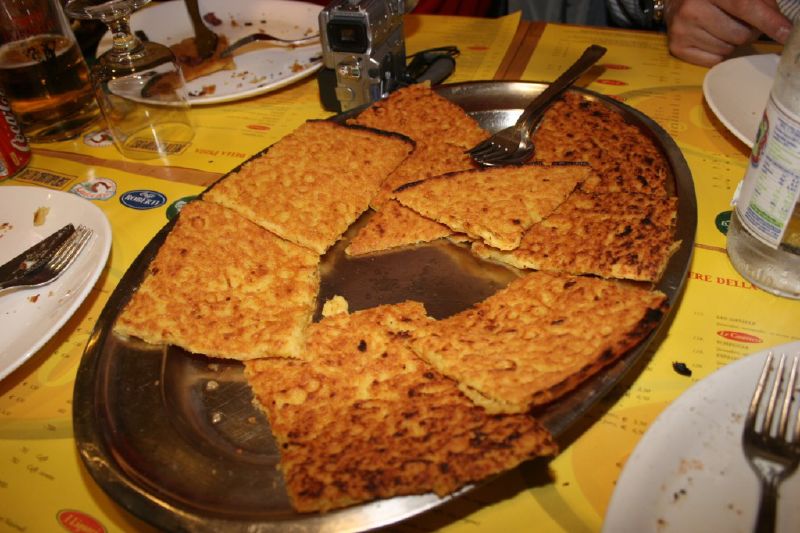
Farinata
Thin, savoury pancake made from chickpea flour, common along the northwest Mediterranean
Farinata is a flat, golden pancake made from chickpea flour, olive oil and water, baked until crisp at the edges. It is a staple in Liguria, Italy, and the region around Nice, France, and goes by names like socca and fainá in other places. Usually served hot in slices, it is popular as street food and sometimes eaten with bread or even on pizza.
- Made from chickpea flour, olive oil, and water
- Known as socca in Nice and fainá in Argentina and Uruguay
- Often eaten hot in slices as street food
- Popular with pizza in Argentina and Uruguay
- Naturally vegan and gluten-free
What is Farinata?
Farinata is a thin, unleavened pancake with a golden surface and a soft, creamy inside. It is made from chickpea flour, mixed with water and olive oil, then baked in a wide, shallow pan. The result is usually cut into triangles or wedges. The taste is savoury and nutty, with a hint of olive oil. Sometimes it is topped with black pepper or rosemary, but it is often served plain. The pancake is naturally gluten-free and vegan.
Where does Farinata come from?
The roots of farinata are not clearly known. One story claims Roman soldiers first cooked chickpea flour on their shields. It has long been a common food in Liguria, Italy, and is also found in southeastern France as socca. The dish spread to Algeria, Argentina, and Uruguay, often brought by Ligurian migrants. In each place, it has picked up new names and small changes, but the basic idea remains the same.
How is Farinata made?
To make farinata, chickpea flour is combined with water and olive oil to make a thin batter. This is poured into a large, shallow pan, sometimes made of tin-plated copper. The batter is baked in a hot oven until the edges turn crisp and the inside stays moist. It is usually sliced into rough triangles or wedges for serving. Some cooks add rosemary or season with black pepper and sea salt before baking.


How and when is Farinata eaten?
Farinata is usually eaten hot, often as a snack or light meal. In Liguria and Nice, it is sold by street vendors and served in slices, sometimes with a sprinkle of pepper. In Tuscany, it may be placed inside bread or focaccia. In Argentina and Uruguay, fainá is a common companion to pizza, sometimes even placed on top. In Algeria and Gibraltar, similar pancakes are eaten plain, sometimes with cumin or spicy sauces.
Kinds of Farinata
The dish is known by different names in various regions: socca in Nice, cade in Toulon, cecina in Tuscany, and fainá in Argentina and Uruguay. In Pisa, it is stuffed into focaccia, while in Livorno it is eaten between bread slices. In Algeria, a related dish called calentica is served with cumin and harissa. Gibraltar has calentita (baked) and panissa (fried). The texture and thickness can vary, with some preferring a crisp edge and others a softer center.
What Farinata means
Farinata is a familiar street food in Liguria and the south of France. In Argentina and Uruguay, fainá is so popular that August 27 is celebrated as Fainá Day. In Gibraltar, its versions are considered national dishes. The pancake is often linked to local identity and is a symbol of the regions where it is made. In Toulon, cade is connected to Easter traditions.
Questions people ask about Farinata
What is farinata made of?
Farinata is made from chickpea flour, water, and olive oil. Some versions are seasoned with black pepper or rosemary, but the main ingredients are always the same.
Where does farinata come from?
Farinata is originally from Liguria in northwest Italy and the region around Nice, France. It has also become popular in Argentina, Uruguay, Algeria, and Gibraltar.
Is farinata vegan or gluten-free?
Yes, farinata is both vegan and gluten-free. It contains no animal products or wheat, as it is made with chickpea flour, water, and olive oil.
How is farinata usually served?
Farinata is typically baked in a large, shallow pan and cut into slices. It is served hot, often as street food or a snack, and sometimes with a sprinkle of black pepper or rosemary.
Are there different names or versions of farinata?
Yes, it is called socca in Nice, cade in Toulon, cecina in Tuscany, and fainá in Argentina and Uruguay. Each place may have its own way of serving or eating it.
Good reading and sources
- Buenos Aires' unusual pizza toppingBBC, Article
- Sheer poetry: Yotam Ottolenghi’s chickpea flour recipes, from farinata to chickpea pancakesThe Guardian, Recipe
The facts on this page come from the Wikipedia article "Farinata", written by its contributors and used under the CC BY-SA 4.0 licence, and from its Wikidata record (CC0). Thali rewrote the text in its own words, with AI assistance, and compares every page with the article to make sure no passage is copied. It may be reused under the same CC BY-SA 4.0 licence with a link back.
It may contain mistakes, and it is not dietary or allergy advice: recipes differ from cook to cook. If something is wrong, tell us. Last refreshed 2026-10-03.
More from Italy
All the food of Italy Pizza
🇮🇹 Italy and 4 moreFlatbread topped with tomato, cheese and baked at high heat
Main dish, Lunch, Dinner
Pizza
🇮🇹 Italy and 4 moreFlatbread topped with tomato, cheese and baked at high heat
Main dish, Lunch, Dinner
 RavioliRavioliai
🇮🇹 Italy and 4 moreStuffed pasta parcels, usually square, with varied fillings and sauces
Main dish, Lunch, Dinner
RavioliRavioliai
🇮🇹 Italy and 4 moreStuffed pasta parcels, usually square, with varied fillings and sauces
Main dish, Lunch, Dinner
 Aranciniarancino
🇮🇹 ItalyStuffed and deep-fried rice balls from Sicily
Street food, Snacks
Aranciniarancino
🇮🇹 ItalyStuffed and deep-fried rice balls from Sicily
Street food, Snacks
 Snails as foodMeat
🇲🇦 Morocco and 5 moreLand and sea snails prepared and eaten in many world cuisines
Main dish, Lunch, Dinner
Snails as foodMeat
🇲🇦 Morocco and 5 moreLand and sea snails prepared and eaten in many world cuisines
Main dish, Lunch, Dinner
Its cousins elsewhere
All street food ChapatiVeganचपाती
🇮🇳 India and 4 moreUnleavened flatbread cooked on a griddle and served hot with meals
Bread, Breakfast, Lunch
ChapatiVeganचपाती
🇮🇳 India and 4 moreUnleavened flatbread cooked on a griddle and served hot with meals
Bread, Breakfast, Lunch
 EsquitesVegetarian
🇲🇽 MexicoMexican street snack of cooked corn served in a cup with toppings
Street food, Snacks
EsquitesVegetarian
🇲🇽 MexicoMexican street snack of cooked corn served in a cup with toppings
Street food, Snacks
 Roti canaiரொட்டி சென்னை
🇲🇾 Malaysia and 5 moreUnleavened flatbread tossed thin and cooked until crisp, served with curry or dal
Bread, Breakfast, Snacks
Roti canaiரொட்டி சென்னை
🇲🇾 Malaysia and 5 moreUnleavened flatbread tossed thin and cooked until crisp, served with curry or dal
Bread, Breakfast, Snacks
 Tempura天ぷら
🇯🇵 Japan and 1 moreSeafood or vegetables coated in a light batter and deep-fried
Main dish, Lunch, Dinner
Tempura天ぷら
🇯🇵 Japan and 1 moreSeafood or vegetables coated in a light batter and deep-fried
Main dish, Lunch, Dinner