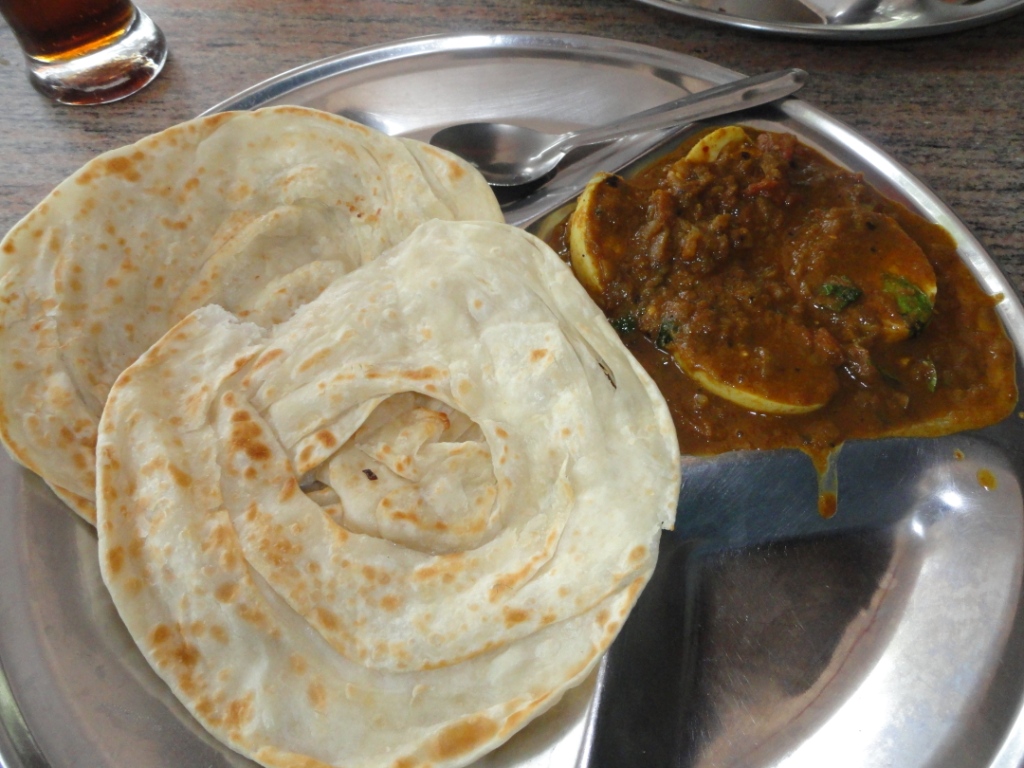
Parotta
Layered flatbread from South India, soft and flakey, made with refined flour
Parotta is a multi-layered flatbread from South India, especially Kerala and Tamil Nadu, made with maida (refined wheat flour), oil, water, and salt. It is soft, flakey, and round, served at any meal with curries, gravies, or tea. Parotta is a staple in South Indian and Sri Lankan cooking, found at homes, street stalls, and restaurants.
- Parotta is a staple bread in Kerala and Tamil Nadu.
- It is made by layering and spiraling dough for a flakey texture.
- Commonly served with beef fry in Kerala and salna in Tamil Nadu.
- Variants include veechu parotta, kothu parotta, and bun parotta.
- Roti canai in Malaysia is based on parotta.
What is Parotta?
Parotta is a round, multi-layered flatbread with a soft, chewy bite and a flakey, pliable texture. Its cream colour is marked by light brown spots from the griddle. Made from maida (refined wheat flour), oil, water, and salt, it sometimes includes egg or sugar. The dough is stretched and folded to create thin, distinct layers, which separate easily when pulled apart. Parotta is usually served hot and is known for its rich, slightly elastic feel and its ability to soak up gravies.
Where does Parotta come from?
Parotta likely reached Kerala through Arab and Central Asian traders, who introduced wheat-based breads to the Malabar Coast. Some believe it evolved from North Indian paratha, but the technique of layering is thought to be foreign to India. Wheat became more common in South India in the 20th century, helping parotta become a staple. The bread spread to Malaysia and Singapore with South Asian migrants, where it became roti canai or roti prata. In Tamil Nadu, parotta became popular during rice shortages, especially in cities like Madurai.
How is Parotta made?
To make parotta, maida flour is mixed with oil, water, salt, and sometimes egg or sugar. The dough is kneaded until smooth, then rested. It is divided into balls, which are beaten and stretched until thin, then folded and shaped into spirals to form layers. The dough is rolled flat and cooked on a hot griddle, flipped with a spatula until both sides are cooked and lightly browned. After cooking, the bread may be gently pulled to separate the layers.


How and when is Parotta eaten?
Parotta is eaten at any time of day, from breakfast to dinner, and is a common street food as well as a restaurant staple. It is served with a variety of curries and gravies—both vegetarian and meat-based. In Kerala, it is often paired with beef fry or chicken curry, while in Tamil Nadu, it is commonly eaten with salna, a tomato-based gravy. Parotta is also enjoyed with tea and is sometimes served on banana leaves. It can be homemade or bought from street vendors, tea shops, or restaurants.
Kinds of Parotta
Malabar parotta is the most common type, known for its fluffy, flakey layers. Veechu parotta is folded into a square and is thinner, while Ceylon parotta is stuffed with meat or egg. Kothu parotta is torn up and mixed with meat, eggs, or vegetables. Other versions include deep-fried poricha parotta, bun parotta with a soft interior, coin parotta in bite-sized rounds, and steamed kizhi parotta wrapped in banana leaves. In Malaysia, it appears as roti canai, and in Trinidad and Tobago as buss-up-shut.
What Parotta means
Parotta is a symbol of everyday life and food culture in Kerala and Tamil Nadu. It is a staple at street stalls, tea shops, and restaurants, and is especially popular in Madurai. Parotta masters are cooks who specialize in its preparation. The bread is so popular that it is the most ordered dish on delivery apps in Kerala. In 2020, a tax ruling on frozen parotta sparked debate about its cultural status, with many defending it as a regional icon.
Questions people ask about Parotta
What is parotta made of?
Parotta is made from maida (refined wheat flour), oil, water, and salt. Some versions also include egg or sugar. The dough is layered and cooked on a griddle to create its signature flakey texture.
Where does parotta come from?
Parotta is from South India, especially Kerala and Tamil Nadu. It is also common in Sri Lanka and has influenced breads in Malaysia and Singapore.
How is parotta different from paratha?
Parotta uses maida (refined flour) and is layered by spiraling and folding, while North Indian paratha uses atta (whole wheat flour) and a different layering method. Parotta is also softer and flakier.
When is parotta usually eaten?
Parotta can be eaten at any meal—breakfast, lunch, dinner, or as a snack. It is served with curries, gravies, or tea.
What are some popular parotta pairings?
In Kerala, parotta is often eaten with beef fry or chicken curry. In Tamil Nadu, it is commonly served with salna, a tomato-based gravy. It can also be enjoyed with vegetarian curries or egg dishes.
Good reading and sources
- Kerala’s signature dish, the Porotta, from Kanhangad to KaliyikkavilaThe Hindu, Article
- Masala Lab | Why maida is not the supervillain of the flour worldMint, Article
- South Indian parotta on WikipediaEncyclopedia
- More photos on Wikimedia CommonsPhotos
- Wikidata recordOpen data
The facts on this page come from the Wikipedia article "South Indian parotta", written by its contributors and used under the CC BY-SA 4.0 licence, and from its Wikidata record (CC0). Thali rewrote the text in its own words, with AI assistance, and compares every page with the article to make sure no passage is copied. It may be reused under the same CC BY-SA 4.0 licence with a link back.
It may contain mistakes, and it is not dietary or allergy advice: recipes differ from cook to cook. If something is wrong, tell us. Last refreshed 2026-10-03.
More from India
All the food of India Samosa
🇮🇳 India and 5 moreFried or baked pastry with a spiced filling, shaped into triangles or cones
Pie or savoury pastry, Snacks, Lunch
Naanनान
🇮🇳 India and 5 moreLeavened flatbread baked in a tandoor or on a pan, soft and spotted with golden brown
Bread, Lunch, Dinner
Samosa
🇮🇳 India and 5 moreFried or baked pastry with a spiced filling, shaped into triangles or cones
Pie or savoury pastry, Snacks, Lunch
Naanनान
🇮🇳 India and 5 moreLeavened flatbread baked in a tandoor or on a pan, soft and spotted with golden brown
Bread, Lunch, Dinner
 Fish and chipsFish or seafood
🇬🇧 United Kingdom and 8 moreBattered fried fish served hot with thick-cut chips
Main dish, Lunch, Dinner
Fish and chipsFish or seafood
🇬🇧 United Kingdom and 8 moreBattered fried fish served hot with thick-cut chips
Main dish, Lunch, Dinner
 ChapatiVeganचपाती
🇮🇳 India and 4 moreUnleavened flatbread cooked on a griddle and served hot with meals
Bread, Breakfast, Lunch
ChapatiVeganचपाती
🇮🇳 India and 4 moreUnleavened flatbread cooked on a griddle and served hot with meals
Bread, Breakfast, Lunch
Its cousins elsewhere
All breads BriocheVegetarianune brioche
🇫🇷 FranceFrench bread made with eggs and butter, often shaped in rounds or loaves
Bread, Breakfast, Snacks
BriocheVegetarianune brioche
🇫🇷 FranceFrench bread made with eggs and butter, often shaped in rounds or loaves
Bread, Breakfast, Snacks
 Pão de queijoVegetarian
🇧🇷 BrazilCheese-filled rolls made with cassava flour, a breakfast and snack food from Brazil
Bread, Breakfast, Snacks
Pão de queijoVegetarian
🇧🇷 BrazilCheese-filled rolls made with cassava flour, a breakfast and snack food from Brazil
Bread, Breakfast, Snacks
 Bagel
🇵🇱 Poland and 2 moreRing-shaped bread roll, boiled then baked for a dense, chewy texture
Bread, Breakfast, Lunch
Bagel
🇵🇱 Poland and 2 moreRing-shaped bread roll, boiled then baked for a dense, chewy texture
Bread, Breakfast, Lunch
 Buñuelo
🇪🇸 Spain and 5 moreCrisp or fluffy fried dough, sweet or savory, enjoyed across Spain and Latin America
Sweet or dessert, Snacks, Breakfast
Buñuelo
🇪🇸 Spain and 5 moreCrisp or fluffy fried dough, sweet or savory, enjoyed across Spain and Latin America
Sweet or dessert, Snacks, Breakfast