Tangyuan
In its own language: 汤圆 / 湯圓
Glutinous rice balls, often filled, served in sweet or savory broth
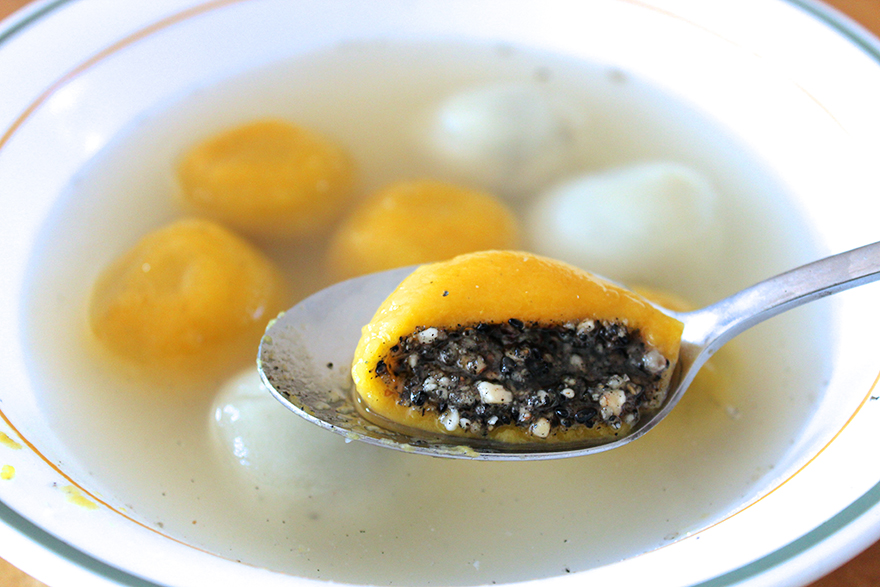
Tangyuan are soft, chewy balls made from glutinous rice flour, sometimes filled with sweet or savory mixtures. Originating in southern China, they are served in a hot broth or syrup and eaten during the Lantern Festival, Chinese New Year, weddings, and family reunions. Fillings and soup bases vary by region and occasion.
- Tangyuan are glutinous rice balls, often filled and served in sweet or savory broth
- Traditionally eaten during the Lantern Festival and Chinese New Year
- Fillings include black sesame, peanut, red bean, and meat
- Southern China favors tangyuan, while the north prefers yuanxiao
- Modern versions include chocolate and custard fillings
What is Tangyuan?
Tangyuan are round dumplings made from glutinous rice flour, ranging in size from small marbles to ping-pong balls. They can be plain or stuffed with fillings like black sesame, peanut, or red bean paste. The texture is soft and chewy, and they are usually served in a warm, sweet syrup or a clear, savory broth. Some versions are colored, fried, or served in dessert soups. Both sweet and savory varieties exist, and the dish can be adapted with modern fillings such as chocolate or custard.
Where does Tangyuan come from?
Tangyuan originated in southern China and have been eaten for over 2,000 years. The dish is closely tied to the Lantern Festival, symbolizing reunion and completeness due to its round shape and the similarity of its name to the word for 'reunion'. According to legend, the festival and tangyuan are linked to a palace maid named Yuanxiao during the Han Dynasty. Over time, tangyuan spread across China and took on various names and forms, with the southern style known as tangyuan and the northern as yuanxiao.
How is Tangyuan made?
To make tangyuan, glutinous rice flour is mixed with water to form a dough, which is then shaped into balls by hand. If filled, a portion of dough is wrapped around a sweet or savory paste, such as black sesame mixed with sugar and fat, or minced meat and vegetables. The balls are boiled until they float, then served in a hot syrup or broth. Sweet versions often use ginger and rock sugar, while savory ones may use clear soup with daikon or fish cake.


How and when is Tangyuan eaten?
Tangyuan are most often enjoyed during festivals like the Lantern Festival, Chinese New Year, and family gatherings, but are now eaten year-round. They are served hot in bowls, sometimes in a ginger-infused syrup for sweet versions or a light broth for savory ones. In southern China, tangyuan are both a dessert and a special dish at meals, while in the north, the similar yuanxiao is preferred. Frozen tangyuan are widely available for convenience.
Kinds of Tangyuan
Regional and international versions of tangyuan include Ningbo tangyuan, which is famous for its black sesame filling, and Chaozhou's ah bho liang with unique fillings. In northern China, yuanxiao are made by rolling filling in dry rice flour, resulting in a different texture. Across Asia, similar desserts exist: Japan's daifuku, Korea's gyeongdan, Indonesia's wedang ronde, Malaysia's buah Melaka, Myanmar's mont lone yay baw, Thailand's bua loi, and Vietnam's chè trôi nước, each with local flavors and ingredients.
What Tangyuan means
Tangyuan carries deep cultural meaning, symbolizing unity and togetherness. Its round shape and the act of sharing it with family reflect hopes for reunion and harmony. The dish is central to the Lantern Festival and other celebrations, and its name is associated with good fortune. Over time, tangyuan has become a year-round treat, with both traditional and modern versions found in homes and shops throughout China and overseas Chinese communities.
When Tangyuan is on the table
Questions people ask about Tangyuan
What is tangyuan made of?
Tangyuan is made from glutinous rice flour shaped into balls, sometimes filled with sweet or savory mixtures such as black sesame, peanut, red bean paste, meat, or vegetables.
Where does tangyuan come from?
Tangyuan originated in southern China and has been eaten for over 2,000 years, especially during the Lantern Festival and other important family gatherings.
How is tangyuan served?
Tangyuan is usually served hot in a sweet syrup flavored with ginger and rock sugar or in a clear, savory broth. It can be eaten plain or filled, depending on the region and occasion.
Are there different types of tangyuan?
Yes, there are many regional and modern variations. Fillings and soup bases vary, and similar dishes exist in other Asian countries, each with its own local twist.
When is tangyuan traditionally eaten?
Tangyuan is most closely associated with the Lantern Festival, Chinese New Year, weddings, and family reunions, but it is now enjoyed throughout the year.
Good reading and sources
- Why Lunar New Year wouldn’t be complete without glutinous rice ballsSouth China Morning Post, Article
- A Chinese sweet that’s a homophone for reunionBBC, Article
The facts on this page come from the Wikipedia article "Tangyuan", written by its contributors and used under the CC BY-SA 4.0 licence, and from its Wikidata record (CC0). Thali rewrote the text in its own words, with AI assistance, and compares every page with the article to make sure no passage is copied. It may be reused under the same CC BY-SA 4.0 licence with a link back.
It may contain mistakes, and it is not dietary or allergy advice: recipes differ from cook to cook. If something is wrong, tell us. Last refreshed 2026-10-03.
More from China
All the food of China Candy
🇺🇸 United States and 5 moreSmall sweet treats made mainly from sugar or sweeteners
Sweet or dessert, Snacks
CaviarFish or seafood
🇮🇷 Iran and 5 moreSalt-cured fish roe, most prized from sturgeon of the Caspian and Black Sea
Sauce, pickle or ferment, Snacks
Candy
🇺🇸 United States and 5 moreSmall sweet treats made mainly from sugar or sweeteners
Sweet or dessert, Snacks
CaviarFish or seafood
🇮🇷 Iran and 5 moreSalt-cured fish roe, most prized from sturgeon of the Caspian and Black Sea
Sauce, pickle or ferment, Snacks
 Laba garlicVegan
🇨🇳 ChinaGarlic cloves pickled in vinegar for the Laba Festival in northern China
Sauce, pickle or ferment
Laba garlicVegan
🇨🇳 ChinaGarlic cloves pickled in vinegar for the Laba Festival in northern China
Sauce, pickle or ferment
 Foie grasMeat
🇫🇷 France and 5 moreFattened duck or goose liver, a French delicacy served whole or as a spread
Main dish, Lunch, Dinner
Foie grasMeat
🇫🇷 France and 5 moreFattened duck or goose liver, a French delicacy served whole or as a spread
Main dish, Lunch, Dinner
Its cousins elsewhere
All sweets and desserts Pie
🇬🇧 United Kingdom and 5 moreA baked dish with a pastry crust and sweet or savoury filling
Main dish, Lunch, Dinner
Pierogi
🇵🇱 Poland and 6 moreDumplings of unleavened dough filled with savory or sweet mixtures
Dumpling, Lunch, Dinner
Pie
🇬🇧 United Kingdom and 5 moreA baked dish with a pastry crust and sweet or savoury filling
Main dish, Lunch, Dinner
Pierogi
🇵🇱 Poland and 6 moreDumplings of unleavened dough filled with savory or sweet mixtures
Dumpling, Lunch, Dinner
 Varenykyвареники
🇺🇦 Ukraine and 1 moreUkrainian dumplings filled with sweet or savoury ingredients
Dumpling, Lunch, Dinner
Varenykyвареники
🇺🇦 Ukraine and 1 moreUkrainian dumplings filled with sweet or savoury ingredients
Dumpling, Lunch, Dinner
 MunguzáVegetarian
🇧🇷 BrazilBrazilian sweet porridge of whole corn, milk and sugar served at winter festivals
Sweet or dessert, Snacks, Tea time
MunguzáVegetarian
🇧🇷 BrazilBrazilian sweet porridge of whole corn, milk and sugar served at winter festivals
Sweet or dessert, Snacks, Tea time