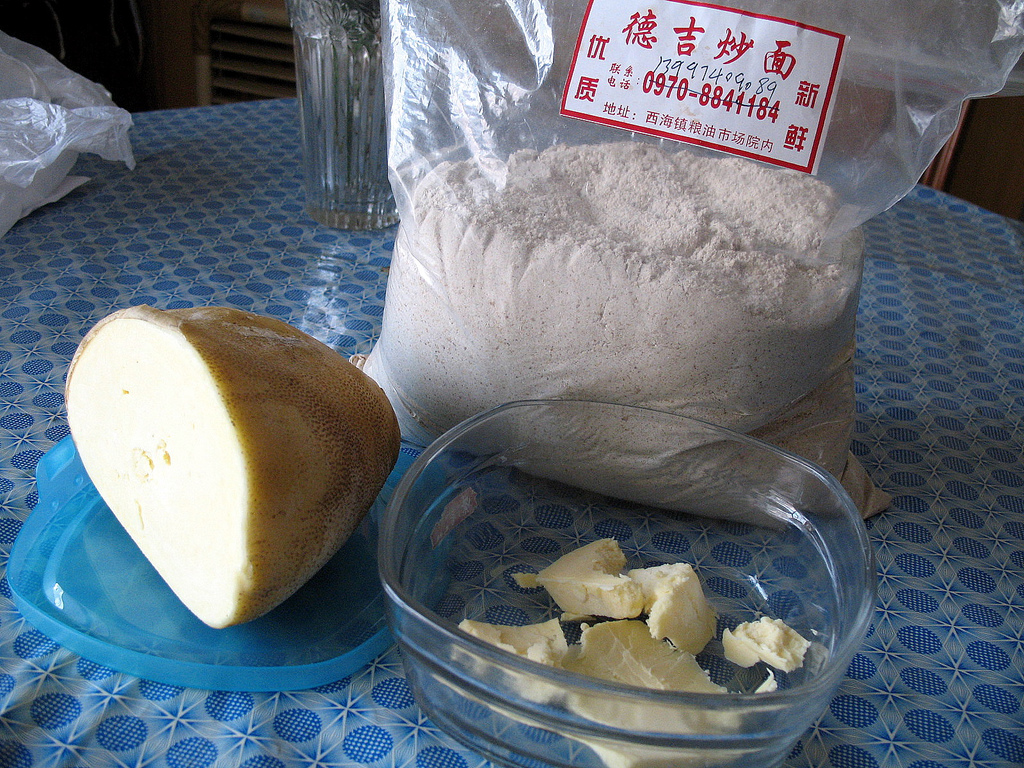
Tsampa
In its own language: རྩམ་པ་
Roasted barley flour mixed with tea or water, a staple in Tibet and the Himalayas
Tsampa is a staple food in Tibet and the Himalayan region, made from roasted flour—most often barley, but sometimes wheat or tree peony seed. It is usually mixed with Tibetan butter tea or water to form a dough or porridge, and is valued for its simplicity and energy. Tsampa is eaten daily and plays a role in Buddhist rituals and celebrations.
- Made from roasted barley or wheat flour, ready to eat without cooking
- Usually mixed with butter tea to form a dough or paste
- Thrown in the air during Buddhist rituals and celebrations
- Eaten daily in Tibet, Nepal, and Mongolia
- Valued by travelers and nomads for its convenience and energy
What is Tsampa?
Tsampa is a basic food made from flour that has been roasted, most commonly barley but sometimes wheat or even tree peony seeds. The flour is mixed with liquids such as Tibetan butter tea, water, or beer to form a dough or a thick paste. Sometimes it is prepared as a sweet or nutty porridge with cheese, butter, tea, and sugar, or as a congee using lamb or yak stock. Tsampa is glutinous and filling, with a nutty, roasted flavor. It is easy to carry and prepare, making it a favorite among travelers and nomads.
Where does Tsampa come from?
Tsampa has long been a staple in Tibetan and Himalayan diets, and is also found in Mongolia and northern Nepal. Its origins are closely tied to the need for a portable, nourishing food for people living in high-altitude, harsh environments. The tradition of tsampa predates Buddhism in Tibet, with early uses as offerings to local deities. Over time, it became central to both daily meals and ritual practices, reflecting its deep roots in the region’s culture.
How is Tsampa made?
The flour for tsampa is first roasted, which gives it a distinctive flavor and makes it ready to eat without further cooking. To prepare, a portion of roasted flour is mixed with butter tea, water, or sometimes beer in a bowl. The mixture is kneaded by hand until it forms a dough or dumpling-like ball. For porridge, cheese, butter, tea, and sugar may be added, while savory versions use meat stocks. The process is simple but requires some skill to get the right consistency.


How and when is Tsampa eaten?
Tsampa is eaten at any meal, often as a quick breakfast or a filling snack. It is commonly mixed with butter tea, which adds richness and moisture, and is shaped by hand in the bowl before eating. Travelers and nomads value tsampa for its convenience and energy. It is also served at festivals, Buddhist rituals, and funerals, where pinches of tsampa are thrown into the air as offerings or blessings. Tsampa may be eaten alone or with other foods like cheese or meat stock.
Kinds of Tsampa
While barley flour is traditional, tsampa can also be made with wheat or tree peony seed flour. In Mongolia, it is known as zamba. Sweet versions use sugar and cheese, while savory ones use meat stocks. The porridge form, called jham-thoo, is usually sweet and nutty, while tsam-thug is a congee made with lamb or yak stock. The basic method stays the same, but ingredients and accompaniments change with region and occasion.
What Tsampa means
Tsampa is more than food in Tibetan culture; it is a symbol of identity and community. Throwing tsampa during Buddhist rituals marks joy and celebration, especially at New Year and funerals. The custom is believed to have ancient roots, later woven into Buddhist practice. Tsampa is also seen as a unifying element among Tibetans, sometimes called 'tsampa-eaters' to express shared heritage. Its role in rituals and daily life highlights its cultural and spiritual importance.
Questions people ask about Tsampa
What is tsampa made of?
Tsampa is made from roasted flour, most often barley, but sometimes wheat or tree peony seed flour. It is usually mixed with Tibetan butter tea, water, or beer.
Where does tsampa come from?
Tsampa is a staple food in Tibet and the Himalayan region, and is also eaten in Mongolia and northern Nepal.
How is tsampa eaten?
Tsampa is mixed with butter tea, water, or beer in a bowl and kneaded by hand to form a dough or paste. It can also be made into a sweet or savory porridge.
Is tsampa vegetarian?
Tsampa itself is vegetarian, as it is made from roasted flour. It can be mixed with vegetarian ingredients like butter tea or cheese, but some versions use meat stock.
What role does tsampa play in culture?
Tsampa is central to Tibetan daily life and rituals. It is thrown in the air during Buddhist ceremonies, festivals, and funerals as a symbol of blessing and celebration.
Good reading and sources
The facts on this page come from the Wikipedia article "Tsampa", written by its contributors and used under the CC BY-SA 4.0 licence, and from its Wikidata record (CC0). Thali rewrote the text in its own words, with AI assistance, and compares every page with the article to make sure no passage is copied. It may be reused under the same CC BY-SA 4.0 licence with a link back.
It may contain mistakes, and it is not dietary or allergy advice: recipes differ from cook to cook. If something is wrong, tell us. Last refreshed 2026-10-03.
More from Nepal
All the food of Nepal RajmaVegetarian
🇮🇳 India and 2 moreKidney beans stewed with spices, often served with rice in North India and Nepal
Main dish, Lunch, Dinner
RajmaVegetarian
🇮🇳 India and 2 moreKidney beans stewed with spices, often served with rice in North India and Nepal
Main dish, Lunch, Dinner
 DalVeganदाल
🇮🇳 India and 5 moreSoupy dish made from split lentils, peas or beans, a staple across South Asia
Main dish, Lunch, Dinner
DalVeganदाल
🇮🇳 India and 5 moreSoupy dish made from split lentils, peas or beans, a staple across South Asia
Main dish, Lunch, Dinner
 Momo
🇳🇵 Nepal and 3 moreSteamed dumplings filled with meat or vegetables, served with spicy sauces
Dumpling, Lunch, Dinner
Momo
🇳🇵 Nepal and 3 moreSteamed dumplings filled with meat or vegetables, served with spicy sauces
Dumpling, Lunch, Dinner
 Chow mein炒麵
🇨🇳 China and 5 moreStir-fried noodles with vegetables and often meat or tofu
Noodle or pasta dish, Lunch, Dinner
Chow mein炒麵
🇨🇳 China and 5 moreStir-fried noodles with vegetables and often meat or tofu
Noodle or pasta dish, Lunch, Dinner
Its cousins elsewhere
All main dishes Ga'atVegetarian
🇪🇹 Ethiopia and 1 moreStiff barley or wheat porridge with a spiced butter sauce in the center
Main dish, Breakfast, Lunch
Ga'atVegetarian
🇪🇹 Ethiopia and 1 moreStiff barley or wheat porridge with a spiced butter sauce in the center
Main dish, Breakfast, Lunch
 Crêpe
🇫🇷 FranceThin French pancakes, served sweet or savoury with a range of fillings
Main dish, Breakfast, Lunch
Crêpe
🇫🇷 FranceThin French pancakes, served sweet or savoury with a range of fillings
Main dish, Breakfast, Lunch
 Dampfnudel
🇩🇪 Germany and 3 moreSoft yeast dumplings cooked in a covered pan until golden underneath
Dumpling, Lunch, Dinner
Dampfnudel
🇩🇪 Germany and 3 moreSoft yeast dumplings cooked in a covered pan until golden underneath
Dumpling, Lunch, Dinner
 HarchaVegetarianحرشة
🇲🇦 Morocco and 1 moreCrumbly semolina flatbread cooked on a griddle or pan
Bread, Breakfast, Snacks
HarchaVegetarianحرشة
🇲🇦 Morocco and 1 moreCrumbly semolina flatbread cooked on a griddle or pan
Bread, Breakfast, Snacks