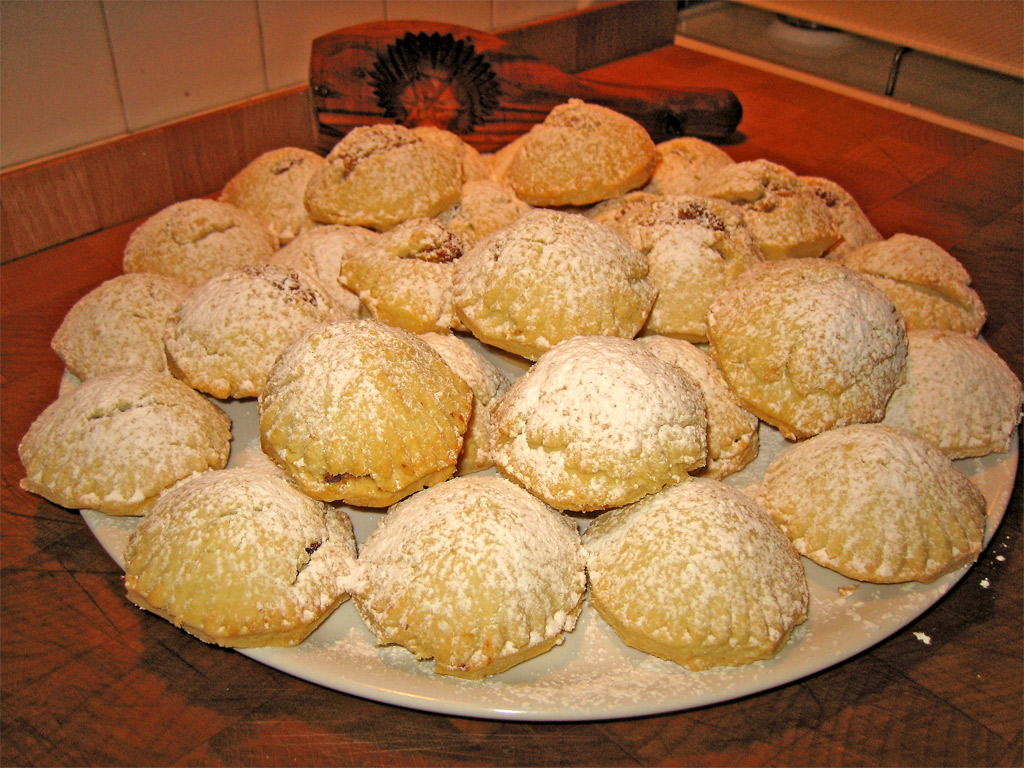
Ma'amoul
In its own language: معمول
Semolina cookies filled with dates or nuts, shaped in moulds for festive occasions
Ma'amoul are filled cookies from the Arab world, made with semolina and butter, and stuffed with dates, figs, or nuts like pistachios and walnuts. Shaped by hand or in wooden moulds, they are especially popular during Eid and Easter, and are often served with coffee and chocolate to guests.
- Traditionally made for Eid and Easter celebrations
- Filled with dates, nuts, or sometimes cheese
- Shaped in wooden moulds with decorative patterns
- Linked to ancient cookies from Mesopotamia and Egypt
- Served with Arabic coffee to guests during holidays
What is Ma'amoul?
Ma'amoul are small, filled cookies made from a dough of semolina and butter. The filling can be sweetened date paste, dried figs, or nuts such as pistachios, walnuts, or sometimes almonds or cheese. They are shaped into balls, domes, or flattened rounds, often decorated with patterns made by hand or pressed into carved wooden moulds. The cookies may be dusted with powdered sugar. Their texture is tender and crumbly, with a rich, buttery taste and a sweet, aromatic filling.
Where does Ma'amoul come from?
Ma'amoul comes from the Arab world, with strong ties to the Levant. Food historians connect it to kleicha, a medieval Mesopotamian date-filled cookie, and to kahk, an ancient Egyptian treat. Written records from the late 19th century describe ma'amoul as a decorated semolina cookie from Syria and Lebanon, sometimes filled with nuts or dates. The name means 'made' or 'manufactured' in Arabic. Over time, ma'amoul became linked to religious and festive celebrations across the Middle East.
How is Ma'amoul made?
To make ma'amoul, semolina and butter are mixed and left to rest, allowing the semolina to absorb the fat. This dough is then wrapped around a sweet filling of dates, nuts, or dried fruit. The filled dough is pressed into a wooden mould, called a tabe, or shaped and decorated by hand. The cookies are then baked until golden. In some regions, spices like mastic, mahleb, saffron, or cardamom are added for extra aroma, and rose water may be used for flavor.


How and when is Ma'amoul eaten?
Ma'amoul is most often served during major religious holidays, such as Eid and Easter, but is also enjoyed year-round. Families prepare them in advance of the festivities, storing them to offer to guests with Arabic coffee or chocolate. The cookies are eaten as a snack or with tea, and sharing them is part of the celebration. In some communities, ma'amoul is also made for Purim and Sukkot, and for iftar during Ramadan.
Kinds of Ma'amoul
Fillings for ma'amoul vary by region and family tradition. In the Arabian Gulf, saffron and cardamom are used, and white flour may replace some semolina. Turkish kömbe is filled with walnuts, ginger, and cinnamon. In Latakia, cheese is used as a filling. Ma'amoul maad is a layered cake version popular in Lebanon, while Hebron in Palestine has a similar dessert called dahdah. Karabij Halab from Aleppo is a pistachio-filled variant served with a marshmallow-like cream.
What Ma'amoul means
Ma'amoul holds a special place in the festive life of the Arab world. It is a symbol of hospitality, made and shared during Eid, Easter, and other holidays. The cookies are part of both Muslim and Christian celebrations, and are also found in Jewish and Samaritan traditions. In Turkey, a related cookie, kerebiç, is registered as a geographical indication. The use of special moulds and family recipes adds to its cultural significance.
When Ma'amoul is on the table
Questions people ask about Ma'amoul
What is ma'amoul made of?
Ma'amoul is made from a dough of semolina and butter, filled with dates, figs, or nuts such as pistachios, walnuts, or almonds. Some versions use cheese or other flavorings like mastic, mahleb, saffron, or cardamom.
Where does ma'amoul come from?
Ma'amoul originates from the Arab world, especially the Levant region, with historical links to Syria, Lebanon, Palestine, and Egypt. It is also found in Turkey, where it is called kömbe.
When is ma'amoul usually eaten?
Ma'amoul is most commonly prepared for religious festivals such as Eid al-Fitr, Easter, Purim, and Sukkot, but it is also enjoyed throughout the year as a snack or with tea.
How is ma'amoul shaped and decorated?
The cookies are shaped into balls, domes, or flattened rounds, and are often pressed into special wooden moulds called tabe, which create decorative patterns that can indicate the type of filling inside.
Are there different types of ma'amoul?
Yes, variations exist across regions. Fillings can include different nuts, dried fruits, or cheese. Some versions are flavored with spices or rose water, and there are layered cake forms and related cookies like karabij and kömbe.
Good reading and sources
- Library of Congress CatalogLibrary of Congress, Article
- The History of Ma'amoul, a Middle Eastern Cookie That Is a 'Love Letter' to Our AncestorsSmithsonian Magazine, Article
- ‘A very sensory experience’: the magic of maamoul, and how to make your ownThe Guardian, Recipe
The facts on this page come from the Wikipedia article "Ma'amoul", written by its contributors and used under the CC BY-SA 4.0 licence, and from its Wikidata record (CC0). Thali rewrote the text in its own words, with AI assistance, and compares every page with the article to make sure no passage is copied. It may be reused under the same CC BY-SA 4.0 licence with a link back.
It may contain mistakes, and it is not dietary or allergy advice: recipes differ from cook to cook. If something is wrong, tell us. Last refreshed 2026-10-03.
More from Syria
All the food of Syria BaklavaVegetarianباقلوا
🇹🇷 Turkey and 5 moreThin pastry filled with nuts and soaked in sweet syrup
Sweet or dessert, Tea time, Snacks
BaklavaVegetarianباقلوا
🇹🇷 Turkey and 5 moreThin pastry filled with nuts and soaked in sweet syrup
Sweet or dessert, Tea time, Snacks
 Qamar al-DinVeganقمر الدين
🇸🇾 Syria and 3 moreThick apricot fruit leather and drink, especially served during Ramadan
Drink, Snacks
Qamar al-DinVeganقمر الدين
🇸🇾 Syria and 3 moreThick apricot fruit leather and drink, especially served during Ramadan
Drink, Snacks
 KnafehVegetarianكنافة
🇵🇸 Palestine and 5 moreShredded pastry layered with cheese and soaked in sweet syrup
Sweet or dessert, Breakfast, Snacks
KnafehVegetarianكنافة
🇵🇸 Palestine and 5 moreShredded pastry layered with cheese and soaked in sweet syrup
Sweet or dessert, Breakfast, Snacks
 Muhallebiمهلبی
🇮🇷 Iran and 5 moreA smooth milk pudding thickened with rice flour or starch, served cold
Sweet or dessert
Muhallebiمهلبی
🇮🇷 Iran and 5 moreA smooth milk pudding thickened with rice flour or starch, served cold
Sweet or dessert
Its cousins elsewhere
All sweets and desserts Qatayefقطايف
🇪🇬 Egypt and 5 moreSweet stuffed pancakes, folded and filled with nuts or cream, served for Ramadan
Sweet or dessert, Snacks, Tea time
Qatayefقطايف
🇪🇬 Egypt and 5 moreSweet stuffed pancakes, folded and filled with nuts or cream, served for Ramadan
Sweet or dessert, Snacks, Tea time
 VanillekipferlVegetarian
🇦🇹 Austria and 5 moreCrescent-shaped vanilla biscuits dusted with vanilla sugar, from Austria and Germany
Sweet or dessert
VanillekipferlVegetarian
🇦🇹 Austria and 5 moreCrescent-shaped vanilla biscuits dusted with vanilla sugar, from Austria and Germany
Sweet or dessert
 Seffaالسفة
🇲🇦 Morocco and 1 moreSweetened couscous or noodles with butter, cinnamon, and almonds
Main dish
Seffaالسفة
🇲🇦 Morocco and 1 moreSweetened couscous or noodles with butter, cinnamon, and almonds
Main dish
 Rum cakeVegetarian
🇬🇾 Guyana and 4 moreA rich cake made with rum-soaked fruits, enjoyed at holidays and celebrations
Sweet or dessert
Rum cakeVegetarian
🇬🇾 Guyana and 4 moreA rich cake made with rum-soaked fruits, enjoyed at holidays and celebrations
Sweet or dessert