🇲🇦 The food of Morocco
23 dishes from Morocco, best known first, across 1 city or region.
Moroccan cooking blends Arab, Berber, Andalusi, Mediterranean, and African traditions, shaped by centuries of trade and migration. Meals center on bread, grains, and richly spiced tagines, with preserved lemons, olives, and dried fruits lending distinctive flavors. Communal eating and ceremonial mint tea are key parts of daily life.
- Ras el hanout can blend up to 27 spices.
- Bread is eaten at nearly every meal.
- Mint tea is poured from a height for bubbles.
- Sardines are Morocco’s top seafood export.
- Halwa chebakia is a Ramadan sweet.
The cooking of Morocco
Moroccan food draws on a long history of cultural exchange, with influences from Arab, Berber, Andalusi, and Mediterranean neighbors. Spices are central, often layered in complex blends like ras el hanout, which may include up to twenty-seven different spices. Meals are often shared from communal dishes, and bread is used to scoop up food. Preserved ingredients such as lemons, smen (aged butter), and olives add depth to many dishes. Tagines, slow-cooked stews named for the clay pot they are cooked in, are a hallmark, as are hearty soups and a wide array of salads. The art of making and serving mint tea is a daily ritual.
Staple foods in Morocco
Wheat and rice are the main grains, with bread and couscous forming the backbone of many meals. Until the mid-20th century, barley was also common, especially in the south. Lamb, beef, chicken, goat, and seafood are widely used, along with vegetables and legumes. Olive oil is now the main cooking fat, though butter and animal fat are still used. Preserved lemons, dried fruits, and a variety of local herbs and spices are frequent additions.
Lunch in Morocco 11 dishes
Lunch is often the main meal of the day, starting with several salads—some raw, some cooked—followed by a tagine or a dish called dwaz. For special occasions, a lamb or chicken dish might follow, or couscous topped with meat and vegetables. Bread is always present, used to scoop up food by hand.
Dinner in Morocco 13 dishes
Dinner tends to be lighter than lunch, often featuring soups like harira or bissara, especially in colder months. Bread is served alongside, and during Ramadan, dates may accompany the meal.
Snacks and street food in Morocco
Street food is common, especially in city squares like Djemaa el Fna in Marrakesh. Popular snacks include ma'quda (potato fritters), snail soup, and sandwiches such as khanz u-bnīn. Dairy shops (mhlaba) offer juices, smoothies, and local breads like msemmen and harcha. In the north, Spanish-style bocadillos are also found.
Sweets and drinks in Morocco
Seasonal fruits are the usual way to end a meal. Sweets like kaab el ghzal (almond-filled pastries) and halwa chebakia (honey-soaked, sesame-sprinkled fritters) are enjoyed, especially during Ramadan. Mint tea is the national drink, poured from a height into small glasses and often served with sugar. Fresh orange juice is also widely available.
From region to region in Morocco
Morocco’s regions shape its food. The south once relied more on barley, while cities like Fes and Taza are known for dishes like taktouka and jowhara. Meknes is famous for mint and olives, Talaouine for saffron, and coastal areas for seafood. Fes is also noted for its pastilla and unique salads.
At the table in Morocco
Meals are typically eaten communally, with diners using bread to pick up food from shared dishes. Pork and alcohol are rarely consumed, in keeping with religious practice. Tea service is a social event, with skillful pouring and presentation valued. Bakeries are found everywhere, reflecting the importance of fresh bread.
Festival and religious food in Morocco
During Ramadan, harira soup and halwa chebakia are traditional at sunset. Special pastries and couscous dishes are prepared for religious and family celebrations, with each region and family having its own variations.
The facts in this overview come from the Wikipedia article "Moroccan cuisine", written by its contributors and used under the CC BY-SA 4.0 licence. Thali rewrote the text in its own words, with AI assistance, and compares every page with the article to make sure no passage is copied. It may be reused under the same CC BY-SA 4.0 licence with a link back.
Cities and regions of Morocco
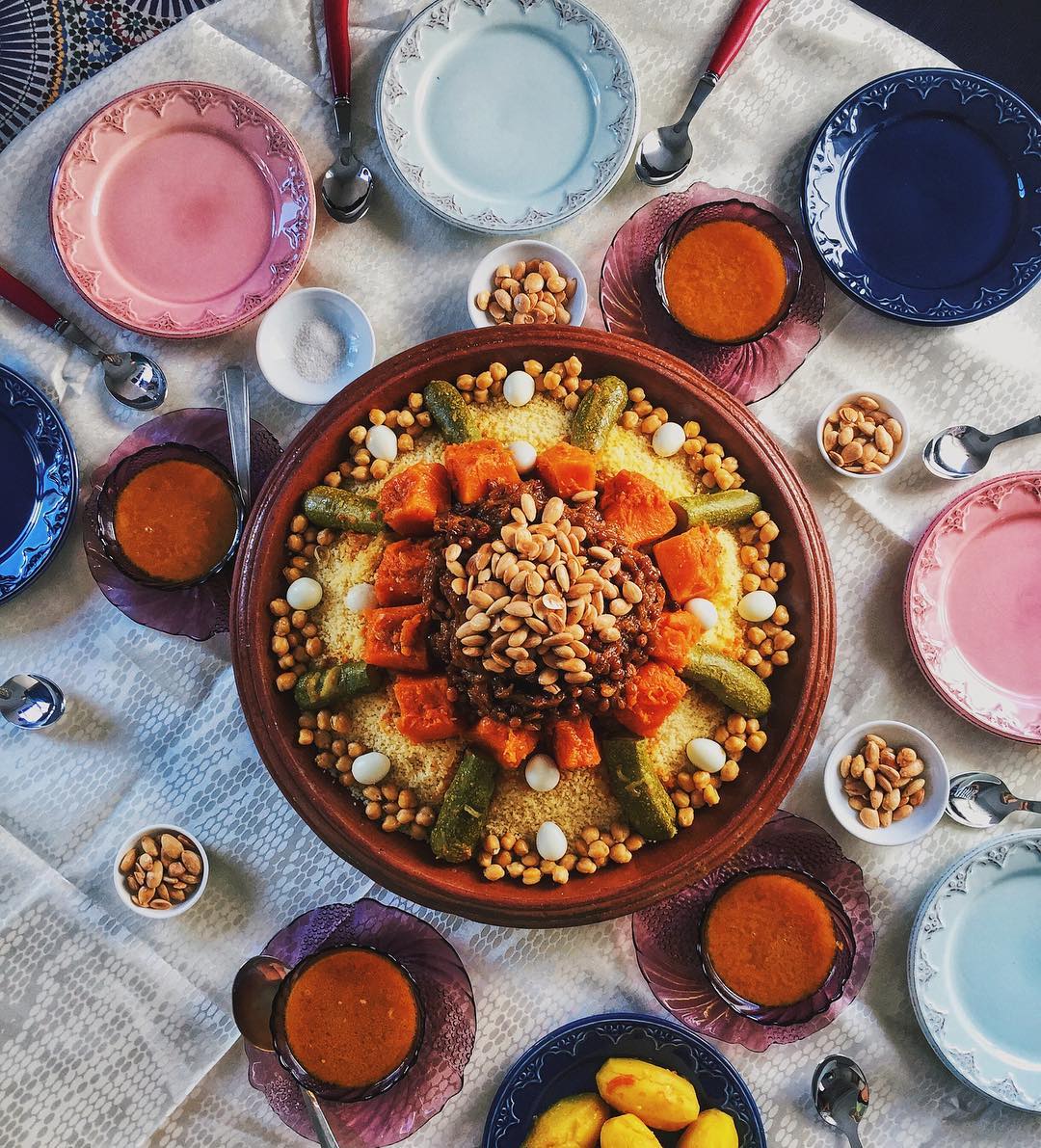 Couscousseksu
🇩🇿 Algeria and 4 moreSteamed semolina granules served with stew or vegetables across North Africa
Main dish, Lunch, Dinner
Couscousseksu
🇩🇿 Algeria and 4 moreSteamed semolina granules served with stew or vegetables across North Africa
Main dish, Lunch, Dinner
 ShakshukaVegetarian
🇹🇳 Tunisia and 5 moreEggs poached in a spiced tomato and pepper sauce from North Africa
Main dish, Breakfast, Dinner
ShakshukaVegetarian
🇹🇳 Tunisia and 5 moreEggs poached in a spiced tomato and pepper sauce from North Africa
Main dish, Breakfast, Dinner
 Tajineطاجين
🇲🇦 Morocco and 4 moreNorth African stew slow-cooked in a cone-lidded clay pot
Main dish, Lunch, Dinner
Tajineطاجين
🇲🇦 Morocco and 4 moreNorth African stew slow-cooked in a cone-lidded clay pot
Main dish, Lunch, Dinner
 Hariraالحريرة
🇲🇦 Morocco and 3 moreNorth African soup of tomato, legumes, herbs and spices, often served during Ramadan
Soup, Dinner, Supper
Hariraالحريرة
🇲🇦 Morocco and 3 moreNorth African soup of tomato, legumes, herbs and spices, often served during Ramadan
Soup, Dinner, Supper
 Ful medamesVeganفول مدمس
🇪🇬 Egypt and 5 moreStew of slow-cooked fava beans with olive oil and spices, a staple across Egypt
Main dish, Breakfast
Ful medamesVeganفول مدمس
🇪🇬 Egypt and 5 moreStew of slow-cooked fava beans with olive oil and spices, a staple across Egypt
Main dish, Breakfast
 Snails as foodMeat
🇲🇦 Morocco and 5 moreLand and sea snails prepared and eaten in many world cuisines
Main dish, Lunch, Dinner
Snails as foodMeat
🇲🇦 Morocco and 5 moreLand and sea snails prepared and eaten in many world cuisines
Main dish, Lunch, Dinner
 Pastillaبسطيلة
🇲🇦 Morocco and 2 moreNorth African pie with layers of thin pastry and a savory or sweet filling
Main dish, Dinner, Lunch
Pastillaبسطيلة
🇲🇦 Morocco and 2 moreNorth African pie with layers of thin pastry and a savory or sweet filling
Main dish, Dinner, Lunch
 BissaraVeganبصارة
🇪🇬 Egypt and 1 moreCreamy fava bean purée with herbs, served as a dip or soup
Soup, Breakfast, Lunch
BissaraVeganبصارة
🇪🇬 Egypt and 1 moreCreamy fava bean purée with herbs, served as a dip or soup
Soup, Breakfast, Lunch
 MrouziaMeatالمروزية
🇲🇦 MoroccoLamb tagine with honey, almonds, cinnamon and ras el hanout
Main dish, Lunch, Dinner
MrouziaMeatالمروزية
🇲🇦 MoroccoLamb tagine with honey, almonds, cinnamon and ras el hanout
Main dish, Lunch, Dinner
 RfissaMeatرفيسة
🇲🇦 MoroccoMoroccan chicken and lentils served over torn flatbread with spices
Main dish, Lunch, Dinner
RfissaMeatرفيسة
🇲🇦 MoroccoMoroccan chicken and lentils served over torn flatbread with spices
Main dish, Lunch, Dinner
 KourdassMeat
🇲🇦 Morocco and 1 moreLamb offal sausage, salted, spiced, sun-dried and boiled for festivals and weddings
Main dish, Lunch, Dinner
KourdassMeat
🇲🇦 Morocco and 1 moreLamb offal sausage, salted, spiced, sun-dried and boiled for festivals and weddings
Main dish, Lunch, Dinner
Photo credits on this page
The small pictures above come from Wikimedia Commons under free licences. Some are cropped to fit.
- Mrouzia: Iron Bishop, CC BY-SA 3.0, source
- Bissara: Ruby Josephine Smith, CC BY-SA 4.0, source
- Rfissa: Mokhtaroo, CC BY-SA 3.0, source
- Pastilla: kochtopf, CC BY-SA 2.0, source
- Harira: وهراني, CC BY-SA 3.0, source
- Shakshuka: Joe Mahoney, CC BY 2.0, source
- Ful medames: Habib M'henni, CC BY-SA 3.0, source
- Couscous: Lmmima, CC BY-SA 4.0, source
- Snails as food: Marianne Casamance, CC BY-SA 3.0, source
- Kourdass: مصطفى ملو, CC BY-SA 4.0, source
- Tajine: Bawdeep2010, CC BY-SA 4.0, source