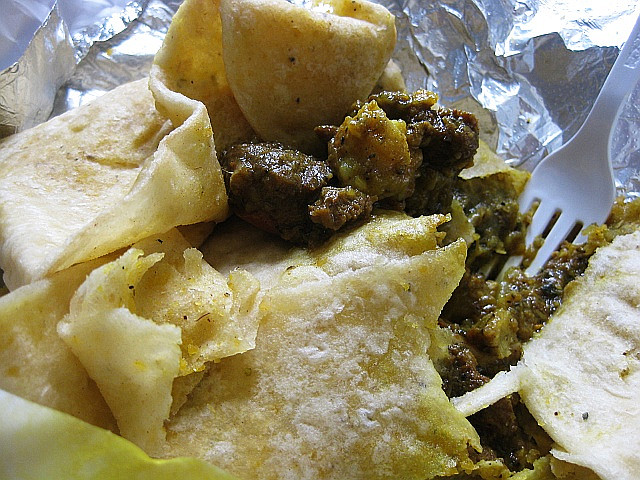
Roti
Curried meat or vegetables wrapped in a Caribbean flatbread
Roti is a Caribbean wrap made by filling a soft flatbread with curried or stewed meats or vegetables, often including potato or chickpeas. Originating in Trinidad and Tobago with Indian roots, it is now popular across the Caribbean and in countries with Indo-Caribbean communities. Both meat and vegetarian versions are common.
- Invented in San Fernando, Trinidad in the late 1930s
- Filled with curried meat or vegetables, often potato or chickpeas
- Uses paratha, dhalpuri, or dosti roti as the wrap
- Popular in Trinidad, Guyana, Suriname, and Jamaica
- Vegetarian fillings are common due to local dietary preferences
What is Roti?
Roti, in the Caribbean sense, is a soft flatbread wrap filled with a spiced curry or stew. The bread itself may be a paratha (layered flatbread), dhalpuri (flatbread stuffed with ground split peas), or dosti roti (softer, thinner roti). The filling is most often curried chicken, goat, or beef, but can also be vegetarian, using potato and chickpeas. The whole wrap is usually hand-sized or larger, rolled up for easy eating. The taste is rich and savory, with the bread soaking up the spicy, fragrant filling.
Where does Roti come from?
Roti wraps trace their roots to Trinidad and Tobago, where Indian indentured workers brought their bread-making traditions after 1838. Originally, roti was a side dish, but in the late 1930s, a Trinidadian snack bar owner in San Fernando began wrapping curries in roti for takeaway customers. This innovation quickly spread across Trinidad and then to Guyana, Suriname, and Jamaica. As Indo-Caribbean people moved abroad, they brought the roti wrap with them, making it a familiar street food in cities with Caribbean communities.
How is Roti made?
To make a Caribbean roti, a large flatbread is cooked on a tava, a flat griddle. The bread may be plain or filled with ground split peas (dhalpuri). The filling is a thick curry, often made with chicken, goat, beef, or sometimes seafood, along with potatoes and chickpeas. The curry is spooned onto the bread, which is then folded or rolled to enclose the filling. The wrap is served whole or cut in half for easy eating.

How and when is Roti eaten?
Roti is eaten as a main meal or a snack, often bought from roti shops or street vendors. It is typically eaten with the hands, as the soft bread holds the curry inside. In Trinidad and Tobago, both meat and vegetarian versions are popular, reflecting the diverse population. Roti is a common lunch or dinner, but can also be eaten as a filling snack throughout the day. It is enjoyed across the Caribbean and in diaspora communities.
Kinds of Roti
There are several variations of roti wraps, depending on the bread and filling. Paratha roti is flaky and layered, while dhalpuri roti has a split pea filling. Dosti roti is thinner and softer. Fillings range from chicken, goat, and beef curries to vegetarian options like potato and chickpeas. Each Caribbean country has its own preferred style, and fillings may also include seafood or other local ingredients.
What Roti means
Roti wraps are a symbol of Indo-Caribbean heritage and everyday Caribbean life. They are sold in dedicated roti shops, especially in Trinidad and Tobago, and have become a staple street food. The dish reflects the blending of Indian and Caribbean culinary traditions. Roti is not tied to any particular festival or religious event, but its popularity is linked to the large Indo-Caribbean communities in the region.
Questions people ask about Roti
What is Caribbean roti made of?
Caribbean roti is a wrap made from a soft flatbread (paratha, dhalpuri, or dosti roti) filled with curried or stewed meats or vegetables, often including potato and chickpeas.
Where did the roti wrap originate?
The roti wrap originated in Trinidad and Tobago, specifically in San Fernando, and spread throughout the Caribbean and to countries with Indo-Caribbean communities.
Is roti always vegetarian?
No, roti can be filled with curried meats such as chicken, goat, or beef, but vegetarian versions with potato and chickpeas are also common.
How is roti usually eaten?
Roti is typically eaten as a main meal or snack, often with the hands, and is popular from street vendors and roti shops across the Caribbean.
What kinds of bread are used for roti wraps?
The wrap can be made with paratha (layered flatbread), dhalpuri (stuffed with split peas), or dosti roti (thin and soft).
Good reading and sources
The facts on this page come from the Wikipedia article "Roti (wrap)", written by its contributors and used under the CC BY-SA 4.0 licence, and from its Wikidata record (CC0). Thali rewrote the text in its own words, with AI assistance, and compares every page with the article to make sure no passage is copied. It may be reused under the same CC BY-SA 4.0 licence with a link back.
It may contain mistakes, and it is not dietary or allergy advice: recipes differ from cook to cook. If something is wrong, tell us. Last refreshed 2026-10-03.
More from Trinidad and Tobago
All the food of Trinidad and Tobago Pakoraपकोड़ा
🇮🇳 India and 5 moreVegetables or other fillings coated in spiced gram flour batter and deep-fried
Street food, Snacks, Tea time
Pakoraपकोड़ा
🇮🇳 India and 5 moreVegetables or other fillings coated in spiced gram flour batter and deep-fried
Street food, Snacks, Tea time
 Roti
🇮🇳 India and 5 moreUnleavened flatbread made from whole-wheat flour, common across South Asia and beyond
Bread, Breakfast, Lunch
Roti
🇮🇳 India and 5 moreUnleavened flatbread made from whole-wheat flour, common across South Asia and beyond
Bread, Breakfast, Lunch
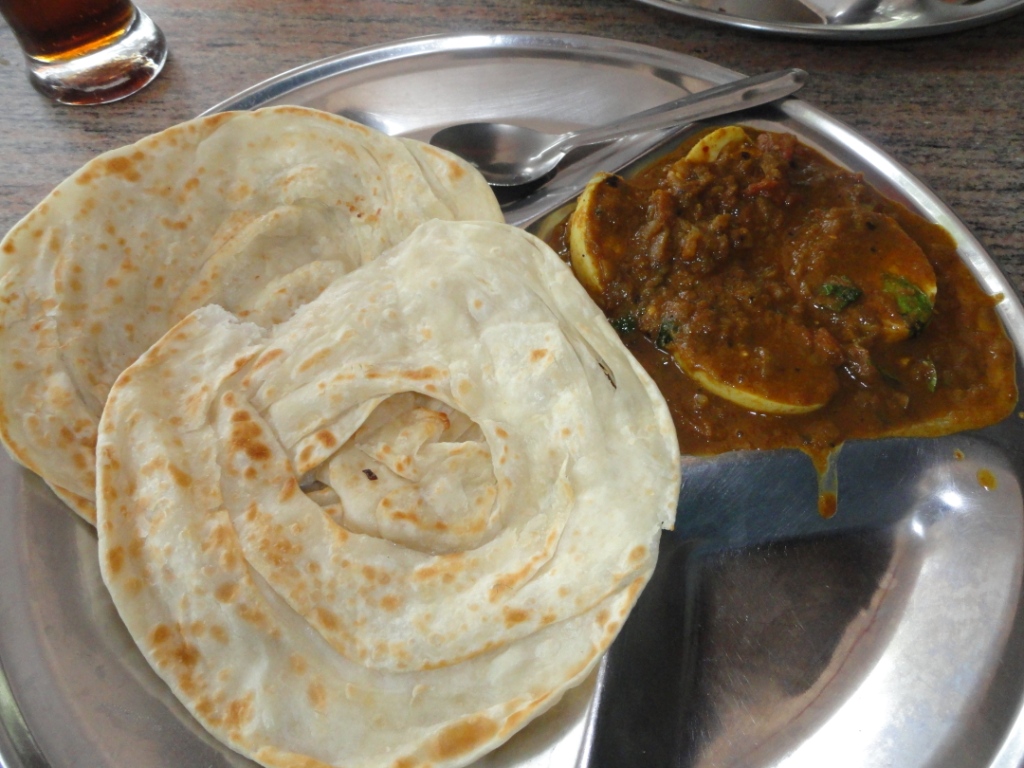 Parotta
🇮🇳 India and 5 moreLayered flatbread from South India, soft and flakey, made with refined flour
Bread, Breakfast, Lunch
Parotta
🇮🇳 India and 5 moreLayered flatbread from South India, soft and flakey, made with refined flour
Bread, Breakfast, Lunch
 DoublesVegan
🇹🇹 Trinidad and TobagoCurried chickpeas tucked between two fried flatbreads, served with chutneys
Street food, Breakfast, Lunch
DoublesVegan
🇹🇹 Trinidad and TobagoCurried chickpeas tucked between two fried flatbreads, served with chutneys
Street food, Breakfast, Lunch
Its cousins elsewhere
All main dishes Masala dosaVegetarian
🇮🇳 IndiaSouth Indian rice-lentil crepe filled with spiced potato
Main dish, Breakfast, Lunch
Masala dosaVegetarian
🇮🇳 IndiaSouth Indian rice-lentil crepe filled with spiced potato
Main dish, Breakfast, Lunch
 PitiMeat
🇦🇿 Azerbaijan and 3 moreMutton and chickpea stew slow-cooked in a sealed crock
Stew or curry, Lunch, Dinner
PitiMeat
🇦🇿 Azerbaijan and 3 moreMutton and chickpea stew slow-cooked in a sealed crock
Stew or curry, Lunch, Dinner
 AbgooshtMeatآبگوشت
🇮🇷 Iran and 2 morePersian lamb and chickpea stew served in stoneware pots
Main dish, Lunch, Dinner
AbgooshtMeatآبگوشت
🇮🇷 Iran and 2 morePersian lamb and chickpea stew served in stoneware pots
Main dish, Lunch, Dinner
 Moussakaμουσακάς
🇬🇷 Greece and 5 moreBaked casserole of eggplant or potato, often layered with meat and sauce
Main dish, Lunch, Dinner
Moussakaμουσακάς
🇬🇷 Greece and 5 moreBaked casserole of eggplant or potato, often layered with meat and sauce
Main dish, Lunch, Dinner